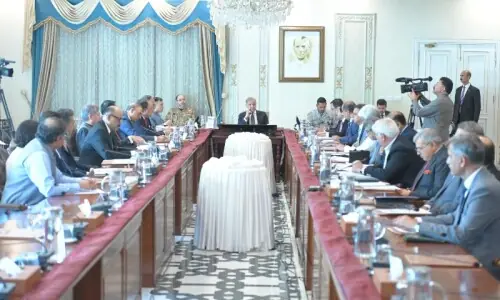
MOSCOW: The United States was joined by Russia, China and Pakistan on Thursday in calling on Afghanistan’s warring sides to reach an immediate ceasefire, at talks that showed Washington’s determination to win backing from regional powers for its plans.
Just six weeks before a deadline for the United States to pull out troops that have been in Afghanistan for nearly 20 years, Washington sent a senior official for the first time to participate in regional peace talks convened by Russia.
The Moscow talks were meant to breathe life into negotiations between the Afghan government and the Taliban in Qatar’s capital Doha, stalled over government accusations that the insurgents have done too little to halt violence.
“At this turning point, our four countries call on the sides to hold talks and reach a peace agreement that will end more than four decades of war in Afghanistan,” a joint statement said after Thursday’s talks.
The statement called on the warring sides to curb violence and on the Taliban not to declare offensives in the spring and summer. It also said the four countries were committed to mobilising political and economic support for Afghanistan once a peace settlement had been reached.
US envoy Zalmay Khalilzad’s presence was a sign of Washington’s increasing effort to attract support among regional powers for its plans for Afghanistan.
President Joe Biden must soon decide whether to keep forces on past a May 1 deadline to withdraw, agreed with the Taliban last year under Biden’s predecessor Donald Trump. Khalilzad has been trying to drum up backing for a proposal that includes an interim government.
Moscow, which fought in Afghanistan in the 1980s, has hosted talks among Afghan sides and regional powers since 2017. Previously, Washington had largely kept its distance from the so-called “Moscow Format”, focusing on its own direct talks with the Taliban and talks between the Afghan parties themselves.
Afghan President Ashraf Ghani opposes an interim government, and a Taliban leader has said the group would not join it, although it supports replacing the current administration.
Abdullah Abdullah, chairman of Afghanistan’s High Council for National Reconciliation, wrote on Twitter after Thursday’s Moscow talks that the state negotiation team was ready to discuss any topic with the Taliban.
“We called for an end to targeted killings and a comprehensive ceasefire to begin the next rounds of the talks in a peaceful environment,” Abdullah wrote.
The Moscow gathering will be followed by a meeting of regional players in Turkey next month and a summit that Khalilzad has asked the United Nations to organise.
Published in Dawn, March 19th, 2021