‘Tough’ to meet May 1 deadline for troop pullout from Afghanistan: Biden


WASHINGTON: US President Joe Biden said on Wednesday that it would be “tough” to withdraw the remaining US troops in Afghanistan by May 1, as was agreed to by the Trump administration.
In an interview with ABC’s Good Morning America, Mr Biden said he was still “in the process” of determining when the forces should leave.
“The fact is that this was not a very solidly negotiated deal that the former president worked out. And so, we’re in consultation with our allies as well as the government, and that decision’s going to be — it’s in process now,” he said.
Earlier this week, the Biden administration announced it was sending its special envoy for Afghanistan, Ambassador Zalmay Khalilzad, to an Afghan peace conference in Moscow, which begins on Thursday. Pakistan is also attending the conference.
On Tuesday, Ambassador Khalilzad said in a tweet that he was wrapping up his second, two-day visit to in Kabul during which he discussed “the latest developments on the (Afghan) peace process with President Ashraf Ghani, Abdullah Abdullah, and a wide range of other leaders, including those in civil society and advocates of women’s rights.
After his first visit to Kabul last week, Ambassador Khalilzad spent several days in Doha, Qatar, discussing the peace process with senior Taliban leaders. He also visited Islamabad last Sunday where he held a series of meetings with senior civil and military leaders and sought Pakistan’s “continued support” for his efforts to seek a peaceful end to the Afghan conflict.
The Biden administration, which assumed power on Jan 20, inherited a peace deal from its predecessors that limits its options for negotiating the end endgame in Afghanistan after almost 20 years of military presence.
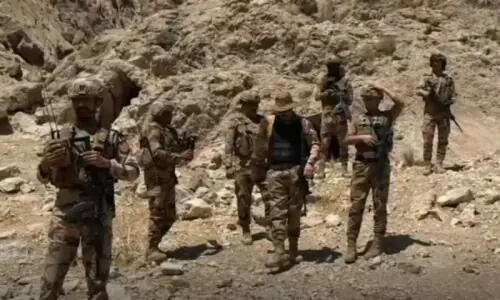
Under the deal, signed in February 2020, former President Donald Trump agreed with the Taliban to pull US troops from the country by May 1. In return, the Taliban committed to keep militants out of Afghanistan and hold direct talks with the Kabul government.
In February 2020, the US had more than 12,000 troops in Afghanistan, down from a peak of more than 100,000 in 2011.
Now 2,500 troops remain, although the New York Times reported last week that about 1,000 more Special Operations forces were also in the country.
Asked how long US troops could remain in Afghanistan, President Biden said, “I don’t think a lot longer,” adding that the May 1 deadline “could happen, but it is tough.”
Mr Biden blamed the delay on the Trump administration’s reluctance in transferring power after the US election. “The failure to have an orderly transition from the Trump presidency to my presidency... has cost me time and consequences,” he said.
Ambassador Khalilzad, who negotiated the deal with the Taliban for the Trump administration, has been retained by the new administration as well.
In a series of tweets after his first visit to the region as Mr Biden’s envoy, Ambassador Khalilzad said he was “encouraged by the fact that all political figures endorse efforts to accelerate the peace process.”
The Afghan leaders, he said, had also agreed to “attend or send delegates to upcoming international engagements for a lasting political settlement and permanent ceasefire.”
However, a US scholar David Andelman told CNN on Wednesday he believed the Biden administration realised that “US troops will need to stay in Afghanistan for a very long time” but was reluctant to share this realization with the American people.
Published in Dawn, March 18th, 2021