0
0

THERE has been a debate over the issue of normalising ties with Israel. Although the debate is not new, the circumstances in which this is being discussed are extraordinary, as Arab countries are normalising ties with Israel one after the other.
The pressure on and from Saudi Arabia to have relations with the Jewish state has been increasing, and Iran, which is considered a common Arab-Israel enemy, is moving ahead with nuclear ambitions at an extraordinary fast pace.
The primary reason for this speedy normalisation has a significant economic dimension; connecting the Israeli port city of Haifa with the Persian Gulf via a railway network crossing Jordan and Saudi Arabia and constructing the state-of-the-art city of Neom.
In this abrupt re-shaping of geopolitics in the region, Pakistan is made to feel the heat of the matter as well and there might have been some pressure on the issue as well. However, the question that may come to many Pakistani minds is: why should Pakistan normalise ties with Israel, or why should it not?
At a glance, it seems like there is nothing terrible in normalising ties with Israel. Pakistan is currently facing enormous complications concerning the economy and politics which can be fixed overnight.
Pakistan will not need to consider India as a threat anymore. Furthermore, the advancement in technology, recognition at international forums, and considerable investments in megaprojects can be the benefits of this normalisation. But what is the price?
Accepting Israel is not a religious question for Pakistan; it is a political one. Pakistan is a state created in the name of an ideology; the two-nation theory. It is as relevant today as it was back in 1940. The theory states that the two nations with ‘distinctive culture and civilisation, language and literature, art and architecture and calendar, history and traditions, aptitudes and a distinctive outlook on life and of life’ cannot live together. Thus, a separate homeland is considered the legitimate right of the oppressed nation.
The idea was duly recognised and appreciated by the British, which ultimately resulted in the creation of a separate homeland for the Muslims of the Indian subcontinent. However, normalising ties with Israel is not only limited to scrapping the ideology of Pakistan, but it goes against Islam’s values and the statute of international law.
Islam’s fundamental values consist of liberty, freedom, equality and equity, justice, peace, humanity, standing against the oppressors and with the oppressed. In the case of Israel, it is a state which came into being by displacing approximately 700,000 people from their homes, strengthens itself by inflicting devastating wars against its neighbours, and plans to survive by dissolving the state of Palestine into the world’s largest open-air prison.
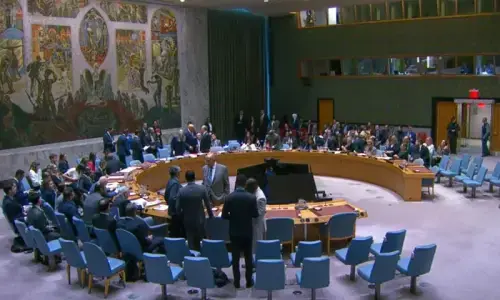
Moreover, if Pakistan moves towards normalising ties, it would also go against the statute of international law. There are plenty of United Nations Security Council resolutions which call for the resolution of Palestinian issue by forcing Israel to accept pre-1967 borders or, in short, a two-state solution.
Therefore, as far as Pakistan’s foreign policy is concerned, it can be said that scrapping the ideology of Pakistan, disregarding the values of Islam and abandoning international law is the price Pakistan is required to pay to normalise ties with Israel.
Syed Rameez Naqvi
Attock
Published in Dawn, February 16th, 2021