Man seeking son's body charged under anti-terror law in occupied Kashmir


 35
35


Police in India-occupied Kashmir have charged a man seeking the body of his teenage son, who was slain by government forces, with conspiring to organise illegal processions, officials said on Monday.
Police said Mushtaq Ahmed and six others, including his two brothers, were charged last week under India’s harsh anti-terror law, the Unlawful Activities (Prevention) Act.
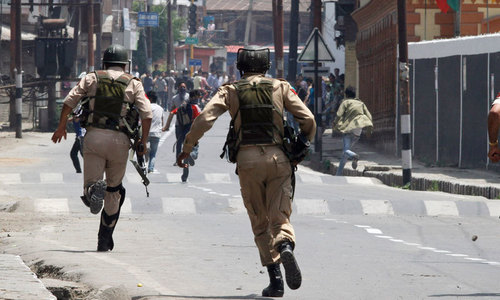
Indian government forces fatally shot Ahmed’s 16-year-old son, Athar Mushtaq, and two other young men on Dec 30 during what police described as a gunfight after the men refused to surrender on the outskirts of Srinagar city. They described the men as “hardcore associates of terrorists” opposed to Indian rule in Kashmir.
Authorities buried them at a remote graveyard about 115 kilometres from their ancestral villages. Under a policy started in April 2020, Indian authorities have buried over 150 alleged Kashmiri fighters in unmarked graves, denying their families proper funerals. The policy has added to widespread anti-India anger in the region.
The young men’s families have protested repeatedly, seeking their bodies while insisting they were not militants and were killed in cold blood.
The killings and remote burial drew widespread public mourning. Videos on social media in which Ahmed sought his son’s body triggered an outburst of emotions as thousands rallied behind a “return the bodies” campaign.
Last month, Ahmed dug a grave for his son at his village, demanding that his body be exhumed and returned for burial at his ancestral graveyard. The grave remains empty.
Two police officials who spoke on condition of anonymity in keeping with government regulations said the defendants conspired to organise illegal processions, abetted anti-national elements, and spread disaffection against the state.
The defendants have not yet been taken into custody.
The anti-terror law was amended in 2019 to allow the government to designate an individual as a terrorist. Police can detain a person for six months without producing any evidence, and the accused can subsequently be imprisoned for up to seven years. Rights activists have called the law draconian.
“Police are seeking my silence,” Ahmed said by phone from his home on Monday. “But I refuse to be silenced. I will keep seeking justice and my son’s body.”
India has long relied on military force to retain control over occupied Kashmir. An armed struggle since 1989 against Indian control and subsequent Indian crackdown has killed tens of thousands of civilians, fighters and government forces.
In August 2019, India revoked Kashmir’s semiautonomous status, clamped curfews and communication blackouts on the territory and arrested thousands, sparking outrage and economic suffering. Since then, authorities have introduced new laws and implemented policies that critics say are part of a plan to colonise the volatile region with Indian settlers.