Dog culling continues in Karachi as delays hit making of byelaws
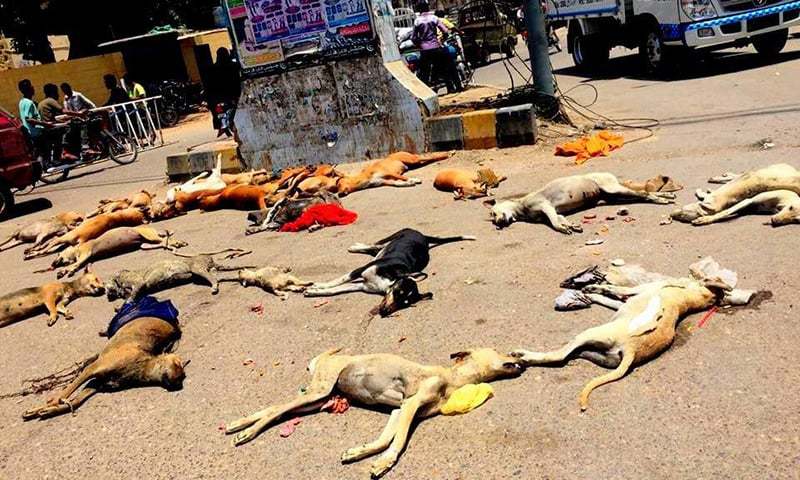


KARACHI: While the province has been seeing a surge in the number of dog bite cases over the years, causing immeasurable human sufferings and increasing hostility against the poor animal in society, the provincial government seems to be in no hurry to make uniform local government byelaws under which officials would be required to provide protection from stray animals and ensure their humane handling, sources told Dawn on Sunday.
The government ‘indifference’, they said, had also led the municipalities to continue with their brutal mass culling practices as means to curb canine population and incidence of their attacks.
The most recent mass dog culling, sources said, took place in the areas of Phase V and VIII of Defence Housing Authority and the Clifton Cantonment Board where many dogs were shot dead. What made the act more gruesome were reports that the municipal staff fired multiple shots to kill one single dog.
“The authorities are quick to take the life of an animal because they fear no retaliation, no backlash or resistance. Who cares about animals in a society where the majority of humans are deprived of life’s basic necessities?” remarked a Clifton resident.
Open garbage dumps
Sources also point to authorities’ inability to see how civilised communities tackled the problem of free-roaming dogs in communities through a mass animal vaccination and birth control programme.
Additionally, they said, studies had shown that dog population thrived in localities with open garbage dumps and suggested that such sites in residential areas with stray dogs increased the risk for different diseases including canine rabies’ transmission.
“Clean up garbage and then the dogs won’t have so much food and will not reproduce so fast. This is well known in veterinary medicine,” said Dr Naseem Salahuddin, head of the Infectious Diseases Department and the Rabies Free Pakistan Project (RFP) of The Indus Hospital (TIH), which also runs a dog-bite treatment centre.
Making byelaws
It is important to mention here that the Sindh Local Government Act 2013 provides room to introduce a system that could provide protection against straying animals and ensure their safety. The government, however, hasn’t yet made bylaws regarding stray and ‘dangerous animals’ for eight years. The case is pending in the court.
Currently, sources said, there were no uniform laws across the province on straying animals. The Cantonments’ Act of 1924 allowed the seizure and destruction of animals, suspected to be suffering from any disease, or dogs ‘which are without collars or marks distinguishing them as private property’.
“We need byelaws under the local government act so that officials are assigned specific duties and held accountable for their job,” said Advocate Tariq Mansoor, a member of the Human Rights Commission of Pakistan, pursuing the case through public interest litigation, adding that court directives helped ensure supplies of free of cost anti-rabies vaccine at government hospitals in the province.
The case also led the government to announce last year a programme mainly focusing on the vaccination and sterilisation of stray dogs. It’s yet to become operational.
RFP needs support
Launched in 2017, the RFP supported by Getz Pharma aims at sterilising and vaccinating stray dogs against rabies so that their population would be controlled and gradually reduced humanely, scientifically and permanently in the long run.
“Moreover, neutered male dogs would lose aggression, thus providing relative safety to pedestrians. Over nearly three years, the RFP has vaccinated over 35,000 dogs and sterilised over 3,200 stray dogs in different localities of Karachi,” said Salahuddin, also a member of the WHO Advisory Panel for Rabies.
According to her, there have been sharp increases in the number of stray dogs in the streets since the Covid-19 lockdown, inflicting serious bites, especially among children.
“At the hospital, we get desperate cries from communities to save them from this calamity. And, while we are doing our bit and providing a public service, the city authorities are undoing the work by poisoning or shooting wantonly all stray dogs, whether neutered and vaccinated, or not.
Published in Dawn, February 8th, 2021