Senate chairman throws his weight behind open ballot move


 5
5


ISLAMABAD: Senate Chairman Sadiq Sanjrani on Friday put his weight behind the demand for transparency in the upcoming Senate elections through open ballot.
In a written synopsis submitted before a five-judge bench of the Supreme Court, the Senate chairman said that openness and transparency in the Senate elections was in the larger national interest. “The Senate does believe that interpretation of constitutional terms or provisions which promotes public welfare, democracy and fairness in the election process is the demand of all stakeholders,” Mr Sanjrani wrote to the court hearing a presidential reference.
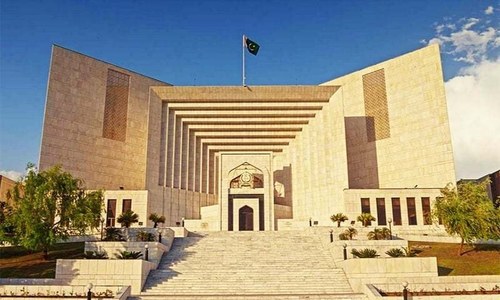
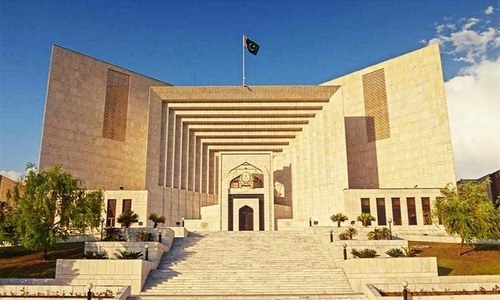
Headed by Chief Justice of Pakistan Gulzar Ahmed, the bench is hearing the reference to answer a question posed by President Arif Alvi if the condition of secret ballot under Article 226 of the Constitution applies to the Senate elections or not.
Written synopsis filed before SC bench hearing presidential reference
Earlier, the National Assembly Speaker Asad Qaiser, too, pleaded before the apex court that parliamentary democracy would be strengthened through open or traceable vote rather than secret ballot in the upcoming Senate elections.
The fresh synopsis furnished through Barrister Mohammad Ali Khan Saif stated that the Election Commission of Pakistan (ECP) was constitutionally charged with the responsibility of holding elections honestly, justly, fairly and in accordance with law — a task could not possibly be performed unless and until constitutional and legal framework for elections was comprehensible, logical and consistent with the best international standards especially with regard to elections of the upper house, the Senate chairman added.
The synopsis argued that during the Senate elections held in March 2015, the issue of rigging and floor-crossing came to limelight leading to the debate regarding mode of elections of senators.
The House Business Advisory Committee (HBAC) of the Senate later took up the matter and after discussing all aspects it was decided that the matter be brought before the upper house for discussion and recommendations.
As per HBAC decision, the mode of elections of Senate members was discussed in the House on Aug 7, 2015. The members debated the issue and expressed views above party lines, it said, adding the Senate after extensive debate felt the need to constitute a committee of the whole on the matter.
Accordingly a motion was moved by the Leader of the House on Aug 10, 2015 and the committee of the whole was constituted to consider mode of elections of the senators, pros and cons of the single transferable voting system, poll reforms and other ancillary matters, the synopsis recalled.
The committee recommended a mechanism of printing name of voter on the ballot paper and giving authority to the party head to seek details after the elections, it said, adding it was the consensus among all stakeholders including the parliamentarians, political parties, intelligentsia, journalists and civil society that free and fair elections to elect members of the Senate would promote transparency and accountability in the electoral process, acknowledge respect for will of the voters, strengthen political parties and their discipline which is essential for the parliamentary democracy.
In any state, the authority of the government could only derive from the will of the people as expressed in genuine, free and fair elections, but the nature of the elections direct or indirect determined the right to vote, the synopsis said, adding that in direct elections secret voting was the fundamental principle whereas if the elections were indirect then electorates were bound to follow party lines.
The Senate chairman said elected representatives were answerable both to voters and party and they were bound to follow the party line while voting, arguing that the party that had awarded them ticket to contest the elections had some legitimate expectations about which an electorate was supposed to know and if a member had the courage and stand up to say to whom he or she wanted to give vote and then to face the consequences. Meaning thereby, party lines or party directions vis-à-vis indirect elections were not inconsistent with the Constitution or any other law of the land on the subject, he added.
Published in Dawn, January 23rd, 2021