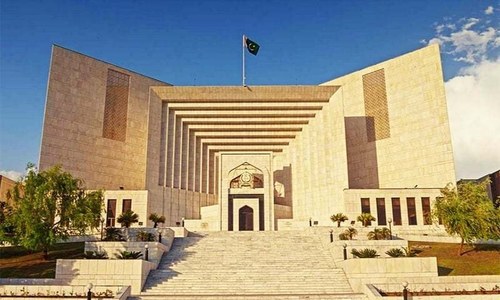
Senate polls always held through secret vote: ECP


ISLAMABAD: The Election Commission of Pakistan (ECP) has informed the Supreme Court that Senate elections have always been held under the Constitution through secret ballot for the purposes of Article 226 of the Constitution.
“Senate elections have always been held through secret ballot after the enactment of the constitution in vogue,” said the ECP in a reply to the court filed by Sajeel Sheryar Swati on behalf of ECP Secretary Dr Akhtar Nazir on Saturday.
Headed by Chief Justice of Pakistan Gulzar Ahmed, a five-judge Supreme Court bench is deliberating upon a presidential reference to answer a question posed by President Dr Arif Alvi whether the condition of secret ballot under Article 226 of the Constitution applied to Senate elections or not. During one of the last hearings, the court, which will resume the hearing on Monday, had asked the ECP to furnish its response to the question.
JI requests SC to return presidential reference seeking its opinion on the issue
In addition to the ECP, Jamaat-i-Islami also furnished a synopsis on Saturday through its lawyer Mohammad Ishtiaq Ahmed Raja with a request to the apex court to return the reference since it was not maintainable for being a question of political nature when another branch of the government, the parliament, existed to redress the controversy.
Meanwhile, the ECP pleaded that holding of Senate elections through open ballot would create an anomaly in the shape of independent members of the assemblies who did not fall under any party discipline when they too were voters for Senate elections.
There were 18 independent members in the National Assembly and provincial assemblies of Punjab, Khyber Pakhtunkhwa and Balochistan, the ECP pointed out.
It recalled that after the enactment of the Elections Act, 2017, the last Senate elections were held in March, 2018, through secret ballot in the light of section 122 of the act.
The commission emphasised that the framers of the constitution chose to place Article 226 in the Constitution which dealt with all elected offices and there was no other provision which dealt with election to any office.
Thus by following the simple rule of statutory interpretation, the ECP said, it would be safe to assert that Article 226 would be all encompassing and taken care of in all elections mentioned in the constitution.
Referring to the rights of the legislators in relation to voting and elections, the commission argued that the fundamental right of freedom of expression as provided under Article 19 of the Constitution would have to be ensured for the independent members during voting for Senate elections. Similarly, a lone parliamentary member present in the assembly would also confront with identical situation as he/she could not be forced to show/share his/her preferences.
Thus the freedom of expression under Article 19 included the freedom to express a political choice through a vote and through a free, neutral and transparent electoral system, the ECP said.
Referring to its possible misapplication in case of open ballot, the commission highlighted that Article 63-A that dealt with disqualification of lawmakers on the ground of defection was framed to stabilise parliamentary democracy in Pakistan in the peculiar context of horse trading (1985 onwards) which badly disrupted the system.
It was felt that a provision specifically to curb this menace was required and therefore the provision was originally introduced through the 14th Amendment, the ECP recalled. Later its scope was expanded through the 18th Amendment.
The commission argued the framers of the constitution deliberately dealt with such practices in a specific article of the constitution.
Moreover, the term party discipline had no constitutional or legal significance though it might have some ethical or political importance and that a lawmaker might be hit by or in terms of Article 63A of the Constitution, the ECP explained.
Hence, it was the constitution and applicable laws that governed the conduct of a lawmaker and not party discipline, the ECP said, adding that the so-called term of ‘dissident member’ had been heard several times but it did not attract any legal action against such member on the mere basis of violation of party discipline (though the party might take action internally) unless his conduct attracted the provisions of Article 63A, the commission said.
Published in Dawn, January 17th, 2021