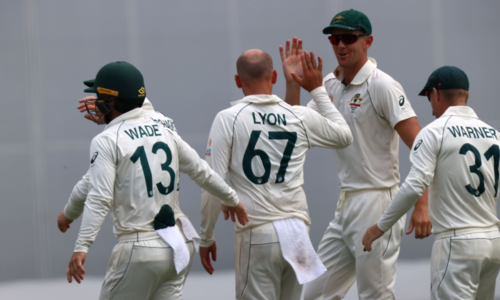
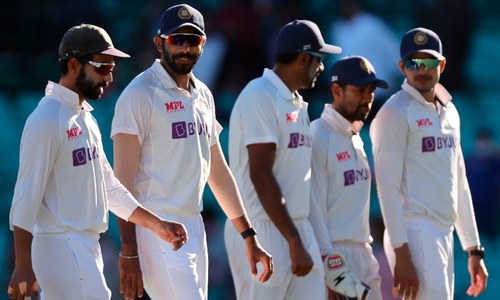
Sundar, Thakur lead unlikely rescue mission for India in series-deciding fourth Test


Washington Sundar and Shardul Thakur led an unlikely rescue mission as India reached 253 for six at tea on the third day of the series-deciding fourth Test against Australia at the Gabba on Sunday.
Sundar and Thakur came together with India in huge trouble at 186 for six but defied expectations to share in an unbeaten 67-run partnership and help India move closer to saving the Test.
India trail Australia's first innings by 116 runs, but without Sundar and Thakur they could have been in far greater trouble.
The two broke the seventh-wicket partnership record for India at the Gabba, beating the previous mark of 58 set by Kapil Dev and Manoj Prabhakar in 1991.
With the series tied at 1-1, India only need to draw the fourth Test to retain the Border-Gavaskar Trophy and with rain forecast for Monday and Tuesday, the fight shown by Sundar and Thakur has made that more of a possibility.
India began the second session at 161 for four with the dangerous Mayank Agarwal and Rishabh Pant at the crease.
But both Agarwal and Pant fell to injudicious shots.
Agarwal slashed at a wide delivery from Pat Cummins's second ball after the resumption to fall for 38, caught at second slip by Steve Smith, and Pant did the same to Josh Hazlewood, only to be caught in the gully by Cameron Green for 23.
At that stage Australia were in command of the Test but debutant Sundar and Thakur, playing just his second Test two years after his first, had other ideas and defied the bowling attack with a mixture of solid defence and attractive stroke making.
Key wicket
Earlier, Mitchell Starc claimed the key wicket of Ajinkya Rahane 20 minutes before lunch as Australia looked to pile the pressure on India after the visitors had looked in control for most of an enthralling opening session.
But with the lunch break in sight, Rahane could not resist playing at a wide ball from left-arm paceman Starc angling across his body and edged a comfortable catch to Matthew Wade at fourth slip.
The Indian captain, on 37, threw his head back in disgust at the manner of his dismissal before trudging off.
He could have fallen twice in the same manner in the opening 30 minutes, but on those occasions the ball flew through a vacant third slip area to the third man boundary.
India began the extended morning session on 62 for two, with Cheteshwar Pujara and Rahane at the crease.
Both men looked to keep the scoreboard ticking over, in contrast to Saturday afternoon, where they were more intent on survival.
They saw off Starc and Pat Cummins but Josh Hazlewood was introduced into the attack and produced a brilliant over which led to Pujara's downfall.
Hazlewood had Pujara in trouble when a short ball followed him as he tried to evade it, the ball hitting his glove and falling just short of Cameron Green in the gully.
But two deliveries later Hazlewood got a ball to angle in, then straighten slightly to catch the outside edge of Pujara's bat and Australia's captain and wicketkeeper Tim Paine took a routine catch.