0
0

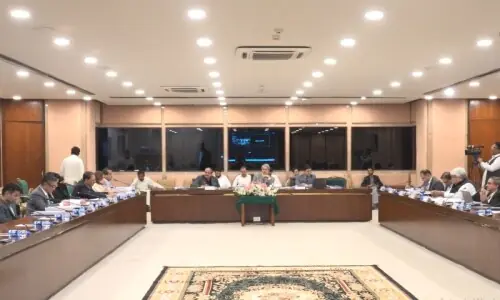
LAHORE: In a national conference held here on Friday, the Pakistan Federal Union of Journalists (PFUJ) gave the government three months to sort out the problems faced by journalists countrywide else “there would be serious consequences”.
The conference was a climax of a campaign ‘Enough Is Enough’ being run by the PFUJ as a response to retrenchments and threats to journalists.
According to PFUJ, almost 8,000 journalists and media workers had lost their jobs over the past couple of years under arbitrary retrenchments and illegal terminations by media managements in complete violation of the laws that govern contracts and employment. They were even denied their rightful dues. There have been instances when journalists and workers were threatened and abused for raising voices for their rights.
Announcing the final statement of PFUJ, its secretary general Nasir Zaidi said journalists and media had been facing the worst-ever suppression they had seen after the government of dictator Gen Zia. But the PFUJ, he said, had never stood for authoritarianism, and never would.
“Our freedom has been trampled, and our rights have been snatched from us,” he said.
“Media owners and the government have made an unholy alliance and workers are the ones who have suffered as a result. I say this while I stand in Lahore, as Lahore has always been the first city to resist any kind of tyranny, or violation of human rights and rule of law. Lahore will resist again and we will hold seminars all over the country inviting civil society to join us.” He said the final seminar would be held in Islamabad in March.
Mr Zaidi said the government had failed to engage with any talks with the representatives of journalists’ associations and there was no framework that could help provide physical, economic and mental security to media workers and if such a framework was not made within three months, there would be nationwide protests, strikes and lockdowns.
Along with Zaidi, other senior journalists were at the panel included I.A. Rehman, Husain Naqi, Shahzada Zulfiqar (also president of PFUJ). Earlier, Abid Saqi from the Punjab Bar Council was there while the panel was later joined by Punjab PPP leader Chaudhry Manzoor.
Zaidi said an ‘immediate, formal and structured dialogue on the finalisation of long-overdue legislation for the protection and safety of journalists was integral to prove that the government was committed to giving media its independence and promoting a free press.
“Provisions that are stifling the electronic, print and digital/social media need to be revisited. Choking voices and silencing dissent are not the solution to anything,” he said. “PFUJ will make its own draft of the journalists’ protection law public. It will also give recommendations for any amendments needed in other media regulatory instruments during the national convention.”
Zaidi said while several instances of intimidation and incident of journalists being physically harmed by ‘unknown culprits’ had occurred, the government had disappointingly only shown indifference by remaining silent. He also mentioned the degradation of the journalists’ working environment and said the government should fairly allocate financial resources to media on basis of consumers. The PFUJ has also urged the government to take measures to ensure complete enforcement of the Wage Board Award under the applicable laws.
I.A Rehman said the only difference between this government and previous governments was that the previous ones saw the media as a ‘necessary evil’, while the current sees it as an ‘unnecessary evil’. He said he was thankful for Punjab Bar Council for helping constitute a panel where the journalists cases were being fought, and said while Pakistani journalists’ past has been glorious, the future seems to hold uncertainty and everyone must unite to counter it.
Husain Naqi said two media groups assets in shapes of plots and buildings were worth billions. Ironically they did not pay their workers on time. He called for joint struggle by journalists, lawyers, social activists for their rights.
Shahzada Zulfiqar said the situation in Balochistan media was extremely dire.
Senior lawyer Hamid Khan said the lawyers would always support freedom of press and remain united with journalists on their agenda. He said it was the worst era after Zia, and that it had become impossible to challenge any aspect of the establishment – not just for journalists but for lawyers as well.
“There have been some heavy investments to cause rifts between lawyers themselves so we become less powerful.”
Chaudhry Manzoor said it was a terrible situation where more than half the sectors had been privatised and the public sectors were facing a dire state of affairs. He said media owners had strengthened press clubs and had made the unions weaker.
Journalist Imtiaz Alam, PML-N’s Azma Bokhari, PFUJ’s ex-president Afzal Butt and Farooq Tariq also spoke.
Published in Dawn, January 16th, 2021