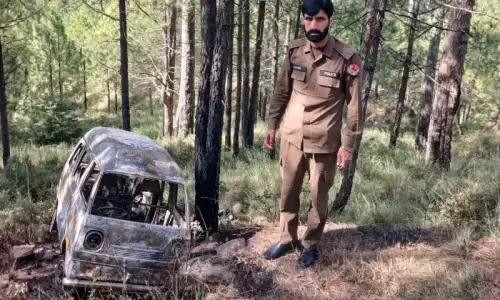
HORROR has revisited the beleaguered Shia Hazara community once again. Early Sunday morning, 11 coal miners, all residents of Quetta’s Hazara Town, were barbarically slain in Balochistan’s mountainous Bolan district in an attack claimed by the militant Islamic State group. The men were apparently asleep in their mudbrick dwelling close by the mine that they worked when the assailants burst in, held them at gunpoint, and bound and blindfolded them.
Then, in an orgy of bestial violence, they slit the victims’ throats. Some bodies also bore gunshot wounds. Prime Minister Imran Khan condemned the massacre as “yet another cowardly inhumane act of terrorism” and ordered the Frontier Corps to apprehend the killers. Further, he assured the victims’ families that the government would not abandon them.
No doubt Mr Khan’s words are well-intentioned. The bitter reality, however, is that the state has long abandoned the Shia Hazaras. In a cynically calculated move, it decided to turn a blind eye to violent extremists’ depredations against the community in the province as long as these murderous groups also served to counter the Baloch insurgency that began during Gen Musharraf’s regime. As a result, nowhere in Balochistan are the Hazaras safe, except for their barricaded ghettoes in Quetta. They have been blown up in suicide bombings and gunned down in the streets, their graveyards filling up with victims, many of them heartbreakingly young. On the cusp of life, these innocents paid the ultimate price for the state’s monumental folly. As for the survivors, their livelihoods, educational opportunities, etc have been eviscerated. Those who can have sought asylum overseas.
While large-scale attacks like those in the first half of 2013 — that together massacred over 200 Hazaras and left more than 500 wounded — have not recurred, mainly because the community has isolated itself within two secure enclaves, they remain in peril. In April 2019, at least 20 people — including 10 Hazaras — were killed in a Quetta marketplace suicide bombing. The attack, which was aimed at the Shias, was also claimed by the IS. It is well known that the virulently sectarian Lashkar-i-Jhangvi, which has a continued presence in Balochistan, works closely with the transnational terrorist group. Surely, in a province crawling with security and intelligence personnel, violent extremists such as these should not be difficult to track down.
They could also be traced through the Ahle Sunnat Wal Jamaat, which also has an overtly anti-Shia agenda. But when one considers that the head of the ASWJ’s Balochistan chapter, Ramzan Mengal, was released from prison — only two days before the marketplace bombing — and allowed to contest the 2018 general election, it becomes clear that there are wheels within wheels here. Certainly, there may be some truth to claims being made that those who slaughtered the coal miners last Sunday are foreign-funded, but the whole truth is far more nuanced.
Published in Dawn, January 5th, 2021