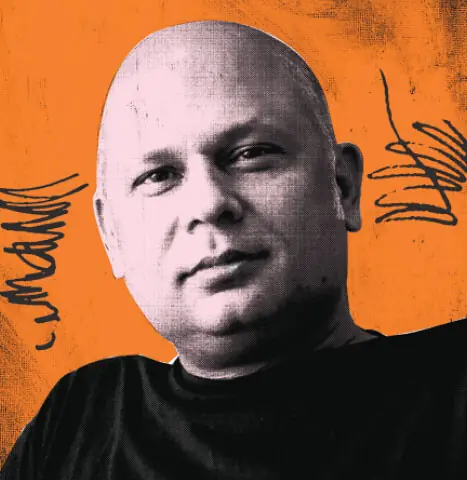
In a country where philosophy is not even taught in most public and private colleges and universities, and where there is a systematic effort by the state and society to wipe out any logical reasoning or rational thought, it is unbearable to lose men such as Kazi Javed and Ashfaq Saleem Mirza.
The sense of loss becomes more acute when we realise that both men used Urdu as their main language of expression. Because of their passing, serious scholarship in Urdu — which is already diminishing — has met a major tragedy, particularly when it comes to original writing and translations in the discipline of philosophy. There is hardly anyone left who either enjoys the same stature, or would be able to contribute the way Javed and Mirza did by dedicating their lives to harness logical thinking in an intellectual wilderness.
We do have some notable scholars of high stature writing in Urdu, but most have a literary lens. From a purely philosophical lens, there are few who would be able to probe the questions surrounding human existence and social order.
Javed authored about two dozen books, from Barr-i-Sagheer Mein Muslim Fikr Ka Irtiqa [The Evolution of Muslim Thought in the Indian Subcontinent] to Tareekh-o-Tahzeeb [History and Civilisation]. He had a wide embrace and wrote about Western philosophical thought and philosophers, history, the impact of colonialism, Punjab’s mystic poets and Shah Waliullah, etc. He also explored the overlaps between Western philosophy and Islamic theology. Javed was an unassuming man who enriched us like few have done.
I had the privilege of knowing Javed, who always met his juniors with a broad smile exuding deep affection. But Mirza’s demise is a deep, personal loss. He was literally a friend, philosopher and guide to me. Mirza had a close association with Javed but, unlike him, Mirza had a conviction that there can be no overlaps between Western philosophical thought and religious theologies.
He was an ardent rationalist and a pure logician. He was uncompromising in his objections to drawing parallels, or finding intersections between philosophy and religious doctrine. Javed used to write regular newspaper columns, which Mirza also did for some years. But after his passion for philosophy, Mirza had a penchant for all forms of art and also wrote on cinema and theatre.
Mirza was a polymath and authored about a dozen books. Other than his stupendous works on Western philosophy in Urdu — from Falsafa: Aik Nayi Taabeer [Philosophy: A New Interpretation] to Machiavelli Se Gramsci Tak [From Machiavelli to Gramsci] — he translated Greek drama and Homer’s Iliad as well. He also wrote essays and papers in English and Urdu on politics and the society of contemporary times. He published a collection of prose poems in his life and his second collection will now be released posthumously. He has left a number of unfinished manuscripts, including one on the ancient history and civilisation of the Greater Indus Valley and another on the history and political thought of the Chinese Communist Party, from Mao Tse-tung to the present day.
Mirza was a free thinker and kept revising himself, posing fresh questions and seeking new answers. His intellectual journey began as a Marxist with a tilt towards Chinese communism. This led to him being politically active in left-wing parties. Not only that, he served the Mazdoor Kissan Party as one of its key office bearers, and intellectually spearheaded the formation of other leftist parties, groups and alliances until a few years ago. He was the most sought after person for penning foundation documents and manifestos for such groups.
However, his inexorable spirit of inquiry would make him question Marxist tenets and explanations. He was a bitter critic of those converting any political ideology into a dogma. But at the same time, he had immense tolerance for people espousing and advocating thoughts and views totally divergent from his own. In his company, one would find individuals of all hues and colours, debating a wide range of ideas and happenings.
I have known only a few writing in Urdu who understood both Friedrich Hegel and Karl Marx as well as Mirza did. That brings him into the league of Syed Muhammad Taqi, Sibte Hasan and Ali Abbas Jalalpuri among the rare scholars of Marxist philosophy we have produced in the past. He was particularly interested and inspired by Hegel’s philosophy of history. While Mirza continued to evaluate the world differently and would not shy away from critiquing Marxism in his later years, he remained committed to secular principles and plural values. But he argued that nothing can improve if the material conditions of people at large in our society do not change for the better.
The year 2020 reminds me of a year from early Islamic history, which is termed Aam-ul-Huzn [The Year of Sorrow]. We have lost so many people around the world because of the pandemic. In our case, the passing away of a significant number of literati and scholars — either because of the pandemic or otherwise — is a huge blow. In an intellectually vibrant society, such people are replaced by similar ones over the course of time; in Pakistan, however, we have neither developed a critical mass of scholarship nor is there currently a desire to create an environment conducive to rational thought and academic freedom. Therefore, once people such as Javed and Mirza leave us, they are seldom replaced.
My last conversation with Mirza, some days before his passing, was about his latest work, the translation of the Iliad in Urdu. He was excited that he could finish a major work in stipulated time. His departure was sudden.
He was hale and hearty when I met him a couple of weeks ago.
Mirza was 76 and Javed was 74. On their deaths, I recalled Faiz Ahmed Faiz’s couplet which he composed after the deaths, in quick succession, of poets Josh Malihabadi and Firaq Gorakhpuri: “Aik saath aaey aik saath gaey/ Asr-i-haazir ke Mir aur Sauda” [Together they arrived and together they left/ The masters of our times such as Mir and Sauda].
The columnist is a poet and essayist based in Islamabad. His latest book is a collection of verse, No Fortunes to Tell
Published in Dawn, Books & Authors, December 13th, 2020