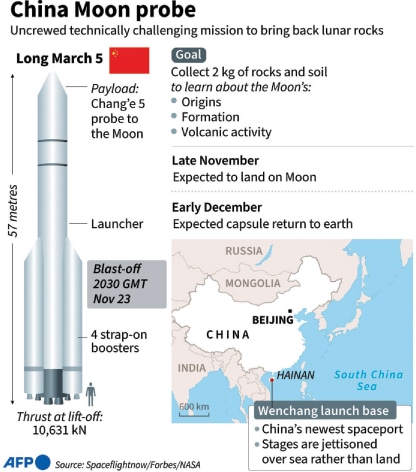
BEIJING: A rocket heading for the moon to bring back the first lunar samples in four decades blasted off from China on Tuesday in the latest milestone for Beijing’s spacefaring ambitions.
China has poured billions into its military-run space programme, with hopes of having a crewed space station by 2022 and of eventually sending humans to the Moon.
The mission’s goal is to shovel up lunar rocks and soil to help scientists learn about the Moon’s origins, formation and volcanic activity on its surface.
State TV footage of the launch showed the rocket blasting off into a dark night and carrying the Chang’e-5 probe — named for the mythical Chinese moon goddess — with huge clouds of smoke billowing out underneath.
The eight-tonne spacecraft took off at 4:30am at the Wenchang Space Centre on the southern island province of Hainan.
Crowds watched the launch from the beach on the tropical Chinese island, holding mobile phones aloft to film as the rocket blasted into the sky.
The original mission, planned for 2017, was delayed due to an engine failure in the Long March 5 rocket.
If successful, China will be only the third country to have retrieved samples from the Moon, following the United States and the Soviet Union in the 1960s and 1970s.
The Chinese probe will collect two kilogrammes (4.5 pounds) of surface material in a previously unexplored area known as Oceanus Procellarum — or “Ocean of Storms” -- which consist of a vast lava plain, according to the science journal Nature.
The probe is expected to land in late November and collect material during one lunar day — equivalent to around 14 Earth days. The samples will then be returned to Earth in a capsule programmed to land in northern China’s Inner Mongolia region in early December, according to US space agency Nasa.
The mission is technically challenging and involves several innovations not seen during previous attempts at collecting moon rocks, said Jonathan McDowell, an astronomer at the Harvard-Smithsonian Center for Astrophysics.
“The US never did a robotic sample return. The Soviet one was very limited and could only land at certain restricted spots,” McDowell said.
Published in Dawn, November 25th, 2020