0
0
HYDERABAD: The results of Hyderabad’s environmental sample for poliovirus detection for the month of October has turned out to be negative after five months since April.
The sample remained positive till September since January and it was only in April when it turned out to be negative. Jacobabad’s sample was again found to be positive, said polio officials.
Qambar-Shahdadkot district’s result of October was negative after remaining positive. With October’s negative result, Dadu also continued to remain negative since April.
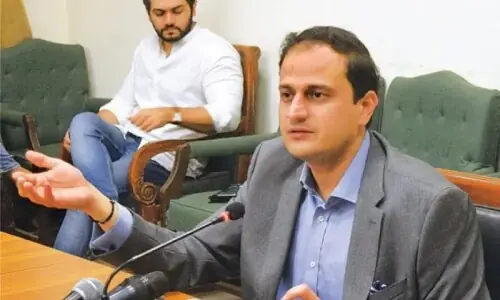
“The negative result of October after April shows that we are now having quality campaigns in our district,” said Hyderabad Deputy Commissioner Fuad Ghaffar Soomro, who was responsible for anti-polio campaigns in the district.
According to him, April’s negative result doesn’t count as it was not result of campaign considering the fact that there was no movement of people due to pandemic. “So, the result of sample ought to have been negative,” he said.
He said that another report of October’s sample was awaited which would show whether the virus was growing locally. “If its report is also negative then it will amount to [a] big achievement,” he said.
Two phases of polio campaign started in Sindh on Oct 26 that ended on Nov 8. Karachi division had a seven-day campaign and the rest of the province had five-day drives.
Emergency Operation Centre (ECO) for Polio spokesperson has commended district administrations and polio teams for good work in last three campaigns. “We had a gap in campaigns due to the Covid-19 pandemic but back to back campaigns since August are now putting us back on right track,” he said.
“We can see progress in environment samples that were previously positive and are now turning out to be negative. If we keep up the hard work we will see major improvements over the coming months,” he added. Around 8.2 million children were to be vaccinated as per target in Sindh. Of them 3pc children were missed, according to EOC. “It makes 231,000 children out of 8.2m,” he said.
Figures showed Hyderabad division reported 99pc coverage in the just concluded campaign, Karachi 93pc, Mirpurkhas 97pc, Shaheed Benazirabad 98pc, Larkana 99pc and Sukkur 100pc.
As for refusals, Hyderabad division has 363 cases among families with 23,000 not available children. A refusal case means that a family is not allowing polio workers to have a child inoculated.
In this campaign, two refusals were recorded and 10,000 children remained unavailable in Mirpurkhas, 55 refusals and 8,000 unavailable in Benazirabad, 136 and 24,000 in Larkana, 33 and 14,000 in Sukkur and 81,500 refusals and 147,000 not available children in Karachi division. “Refusals dropped in Karachi from 102,000 in September and 120,000 in August to 81,500 in October,” he said.
In the just-concluded campaign including two-day catch-up drive trivalent polio vaccine was administered to children under Sindh National Immunisation Drive (SNID).
According to an official, the trivalent vaccine had been discontinued in 2016 after elimination of type-3 virus and the authorities decided to resume injecting the trivalent vaccine after a girl was found affected by the virus in August this year in Tando Hyder area of Hyderabad district.
The environmental sample is collected from designated sites across the province, including Karachi, Hyderabad, Jacobabad, Dadu, Sukkur and Qambar-Shahdadkot. Sindh has 17 designated sites, 11 of which are in Karachi. Hyderabad authorities collect sample on a monthly basis from a designated sewerage pumping station on Tulsidas Road.
Last year, two polio cases were reported in Hyderabad and both were young girls, Ms Rubab Fatima and Memoona. The environmental sample in Hyderabad had remained positive last year.
Officials believed the poliovirus remains present in environment because of dilapidated sewerage system in which sewage lines crisscrossed water supply lines, adding filth to the drinking water. This system was a major source of spread of virus, said the officials.
According to figures, Sindh had 30 polio cases in 2019 and 22 in 2020 so far. In 2019, Hyderabad had 11 polio cases including three in Jamshoro, two each in Dadu and Hyderabad, one each in Tando Allahyar, Sujawal, Badin and Thatta.
In the current year, Hyderabad division has three cases with one each in Badin, Tando Allahyar and Sujawal. In Karachi division, Landhi has one case. Besides, Jacobabad and Ghotki have four each, Qambar-Shahdadkot three, Naushahro Feroze and Kashmore two each, Larkana, Khairpur and Shikarpur one polio case each.
Published in Dawn, November 13th, 2020