Afghanistan withdrawal still 'conditions-based': Top US general


 20
20


The US withdrawal of more troops from Afghanistan will depend on a reduction in violence and other conditions agreed in February with the Taliban, the Pentagon's top general said in an interview broadcast on Monday.
Five days after President Donald Trump said he wants US forces “home by Christmas,” Joint Chiefs Chairman General Mark Milley stressed to NPR radio that pulling out the final 4,500 troops depends on the Taliban reducing attacks and advancing peace talks with the Kabul government.
“The whole agreement and all of the drawdown plans are conditions-based,” Milley told NPR.
“The key here is that we're trying to end a war responsibly, deliberately, and to do it on terms that guarantee the safety of the US vital national security interests that are at stake in Afghanistan.”
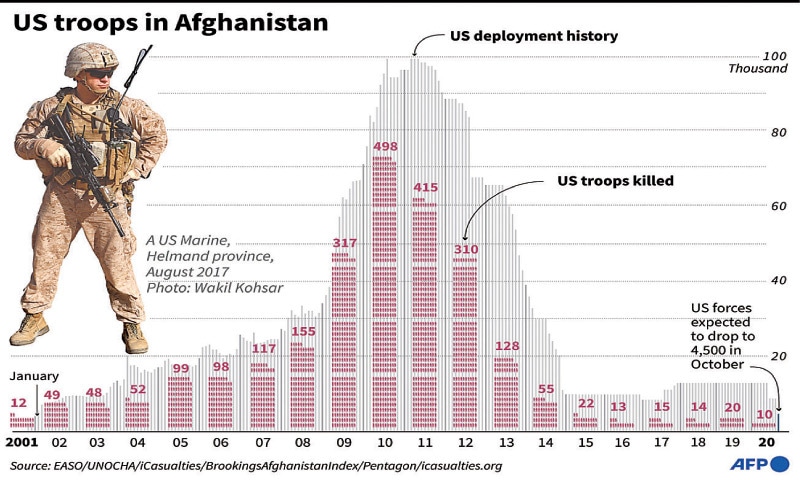
Milley noted that US troop levels had already dropped from 12,000 in the wake of the February pact, which required negotiations between the Taliban and Kabul and a sharp cut in violence.
“That's always been the agreement. That was the decision of the president on a conditions-based withdrawal,” Milley said.
He said violence was well down from several years ago, but the decline in the last four to five months is “not significant.” The Pentagon has envisaged holding the level at around 4,500, expected to be reached by November, into 2021 while it sees how the negotiations in Doha progress.
But policy signals from Washington have been confused.
Last week, Trump's national security advisor, Robert O'Brien, said troops would be cut to 2,500 early next year.
But on Wednesday, Trump tweeted his pledge to have all troops back by December 25.
Trump's pledge came in the context of his uphill battle for reelection on November 3, and a full withdrawal in that short amount of time is seen as logistically impractical and could weaken Kabul in the peace talks.
One of the conditions in the US-Taliban agreement was for the insurgents to halt attacks on urban areas.
But over the weekend, heavy fighting erupted on the outskirts of Lashkar Gah, the capital of Helmand province, and US forces launched air strikes on Taliban fighters.
Milley declined to talk about specific numbers, saying future drawdowns “will be determined by the president.”
“We the military are giving our best military advice on those conditions so that the president can make an informed, deliberate, responsible decision, “he said.