0
0

CHITRAL: The residents of Chitral have complained that natural disasters caused by climate change have exposed the defective designs of various infrastructure projects in the district.
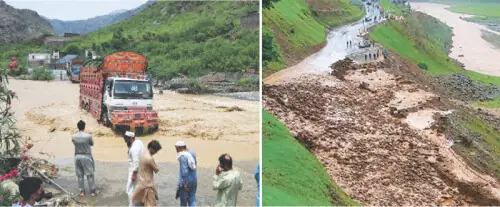
They said that since 2015, glacial lake outburst flood (Glof) and flash floods have played havoc with the road infrastructure, suspension bridges, drinking water supply schemes, irrigation channels and hydropower stations across the district.
The volume of loss to the infrastructures in the summer of 2015 was estimated at Rs16 billion by the Provincial Disaster Management Authority (PDMA) when flashflood caused by the torrential rains devastated Booni road, Garam Chashma road and Kalash valleys road as well as 16 bridges over the Chitral River.
Ex-chief engineer says disaster risk reduction was ignored in planning the projects
The then district nazim, Maghfirat Shah, recalled that the flash flood in July 2015 in Reshun village divested 26,000 households in Upper Chitral of electricity when the 4.2 megawatts hydropower house was washed away.
The powerhouse is yet to be restored.
He said that during the same season, Upper Chitral remained completely cut off from Lower Chitral for over 35 days as the road was washed away in Kuragh and similar situation was witnessed in Garam Chashma and Kalash valleys, which remained disconnected from other parts of the district for many weeks.
The last two years have been marked by Glof in Golen.
On July 7, 2019, the Glof swept away the road and four bridges over a stream, the intake structure of the power channel of 108 megawatts hydropower station of Wapda, the water supply scheme leading to the city and siphon irrigation schemes of four different villages while the valley remained inaccessible for over two weeks.
The Glof on July 13 this year again disconnected the valley from the rest of Chitral for three weeks by sweeping away the roads, bridges and the intake structure of the power channel of the power station for the second time.
A retired chief engineer of a government organisation acknowledged that during designing a project of infrastructure, no provision was made for disaster-risk reduction by making it resilient to the natural hazards hovering over the local environment.
He said on condition of anonymity that Wapda had committed a blunder in Golen by ignoring the 10 glacial lakes in its watershed which had been declared hypersensitive by the meteorological department.
He said that chief consultant of the project Mr George, a German national, had quit his job in protest when Wapda ignored his advice of setting up the structure at a safe place offering resilience to the flood.
“Similar blunders had been committed at all other places in the district where floods have devastated the infrastructures. It is a bitter fact that the department of planning and development has nothing about resilience against natural hazards,” he said.
Former MNA Shahzada Iftikharuddin said that the disaster increased the magnitude of poverty in the area as the funds meant for uplift of people were spent on the rehabilitation of infrastructures.
He claimed that the infrastructures constructed in Chitral since 1947 till 2014 were put to obliteration in the summer of 2015 only due to the faulty design which lacked the element of disaster-risk reduction.
Published in Dawn, October 6th, 2020