0
0

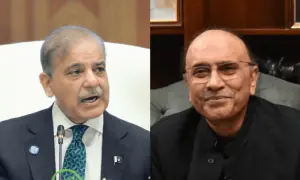
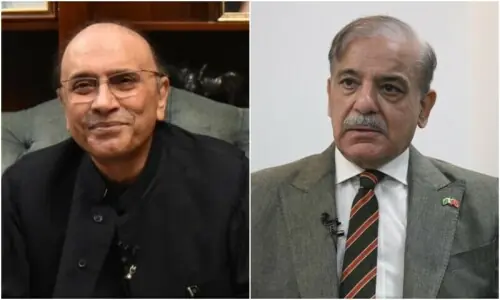
ISLAMABAD: A day after the arrest of Pakistan Muslim League-Nawaz (PML-N) president Shahbaz Sharif by the National Accountability Bureau (NAB) in money laundering case, the leaders of the country’s major opposition parties on Tuesday announced that they would hold their first public meeting from the platform of the newly-formed Pakistan Democratic Movement (PDM) on Oct 11 in Quetta, which would mark the beginning of their anti-government campaign.
The decision was announced by the opposition leaders at a press conference after attending the first meeting of the PDM’s steering committee formed in line with the decisions taken at the opposition’s Sept 20 multiparty conference (MPC) in Islamabad.
PML-N vice-president Shahid Khaqan Abbasi said the “historic” public meeting in Quetta would mark the beginning of their decisive anti-government campaign and after it they would hold public meetings all over Pakistan in line with the MPC’s decisions.
“This (anti-government) movement will keep growing and will be successful in ridding Pakistan of this undemocratic process and will bring a real political change in the country,” said Mr Abbasi.
Opposition alliance condemns ‘shrinking space’ for democracy in country
He said the PDM’s steering committee would comprise two members from each party and its convener would be appointed from all the parties on monthly rotation basis.
PML-N secretary general Ahsan Iqbal has been nominated first convener of the PDM’s steering committee. Next meeting of the steering committee will be held on Oct 5 to finalise the future strategy.
Mr Abbasi said they would soon finalise and send an “organisational structure” of the PDM to the top leadership of their parties after which the plan for the movement aimed at restoring “true democracy” in the country would be given a final shape and presented before the public within one week.
Mr Abbasi said the meeting condemned the “shrinking space” for democracy in the country and discussed “rising inflation, unemployment, historic corruption, the state of economy and people’s grievances.”
Pakistan Peoples Party (PPP) leader Raja Pervez Ashraf said the arrest of Opposition Leader in the National Assembly Shahbaz Sharif was a matter of concern for them. He said there was a consensus among the opposition parties that “such tactics will weaken democracy and cause increase in the anger of Pakistanis.”
Mr Ashraf said the ministers in their news conferences kept on telling the people how many leaders they had arrested and also made predictions about future arrests thus undermining and compromising NAB’s “independent position.” With such things, he said, a common man had also become aware of the “government-NAB nexus”.
The PPP leader said they were not against accountability process, but there was no legal justification for insulting someone.
He said the Oct 11 public meeting would be followed by a series of public meetings in the country.
Maulana Abdul Ghafoor Haideri of the Jamiat Ulema-i-Islam (JUI-F) said the opposition’s movement would continue till the end of the “selected and incapable government.”
Giving a formal shape to their alliance with the name of the PDM and demanding resignation of Prime Minister Imran Khan after their Sept 20 MPC, the country’s 11 major opposition parties had announced that they would launch a three-phased anti-government movement under an “action plan” starting from next month with countrywide public meetings, protest demonstrations and rallies in December and a “decisive long march” towards Islamabad in January 2021.
The eight-hour-long PPP-hosted MPC had also been addressed by deposed prime minister Nawaz Sharif through video link from London.
After the MPC, the opposition leaders had announced that they would use all political and democratic options, including no-confidence motions and en mass resignations from parliament, to seek “the selected prime minister’s resignation and an end to the role of the establishment in politics”.
Published in Dawn, September 30th, 2020