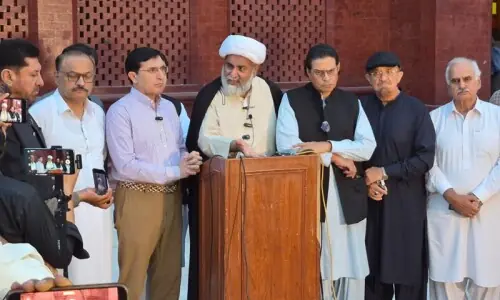
HYDERABAD, Sept 24: A seminar on ‘bonded labour — possibilities of new struggle’ was held here at the press club on Saturday to mark the seventh death anniversary of Shakeel Ahmed Pathan, the first coordinator of the Human Rights Commission of Pakistan’s special task force for Sindh.
Speakers at the seminar called upon the government, judiciary and police to put an end to forced labour and said that two million farmers working in the private jails of landlords should be released.
They said that the feudal system in the country was directly linked with the tribal system. Stressing on the need to implement the Bonded Labour System (Abolition) Act, the speakers said that all the concerned departments should be directed to comply with the act.
They said that district vigilance committees should be activated for rehabilitation of liberated peasants.
Presiding over the session MNA Professor Khalid Wahab paid rich tribute to the late Shakeel Pathan.
He said that Shakeel was the first who had protested over forced labour.
The PPP leaders, Jam Saqi and Aftab Khanzada, and the PML-N provincial leader, Afzal Gujjar, also supported the HRPC’s struggle against the bonded labour.
They said it was not easy to save people from this curse and some serious efforts were needed for it.
Jam Saqi urged the federal and the provincial governments to take measures to stop forced labour so that the doors of international markets would not close on Pakistan.
Aftab Khanzada pointed out that the entire population of the country was subjected to forced labour and there existed only two classes in the country.
The National Labour Federation member, Rana Mehmood Ali Khan, regretted that people did not enjoy political or economic freedom in the country.
He urged the political and the labour organisations to unite on a single platform to launch their struggle.
He said that Pakistan was the only country where feudalism existed and offered his services for drafting a law covering peasants and bonded labours.
Advocate M. Parkash, Ramzan Memon, Zafar Rajput, Perveen Soomro, Master Laljee, Nasreen Shakeel Pathan, the chairperson of the HRCP task force in Sindh, also spoke on the occasion.
The seminar adopted resolutions, demanding police and other agencies to protect liberated farmers and their families who were subjected to harassment after their release.
A resolution was also passed to release the family members of Mannu Bheel who were kidnapped by the landlord of Sanghar in 1998 near Mirpurkhas. Mannu Bheel had been staging token hunger strikes for the past two years.
Another resolution called for distribution of lands among the peasants so that they could live a peaceful life.