0
0

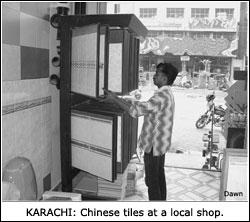 KARACHI, Sept 24: Chinese tiles have captured over 50 per cent market in the last five years but its entry has not driven the local players out of the market. The jump in demand of tiles has created such depth in the local market that there is scope and space for both importers and manufactures of tiles.
Besides, sensing the trend many local manufacturers have made a clever move by venturing into import and manufacturing at the same time.
The cheap price factor of Chinese products have swallowed many well established local manufacturers in fields of toys, children garments, etc., besides giving tough time to the shoe industry, stationary items and garment manufacturers.
Local producers apply two options: either they become distributor or importer of Chinese products or pull their shutter down. Many have packed up their business since their products had failed to compete with cheap Chinese products. However, some local producers take a plunge in trading by becoming importer of Chinese goods in order to survive in hard times.
Perhaps the case of local tile making industry is an exceptional one. The boom in construction activities in almost all segments like upcoming private housing projects, apartments and house renovation in almost all the localities have triggered a massive demand for tiles, thus keeping the industry’s survival prospects alive in future besides opening new trading avenues as long as the construction activities maintain the current level.
Local producers of tiles might have found themselves in hot waters had the demand of tiles in the market not been so strong.
Seven to eight years back, each company used to manufacture 3,000-3,500 square metre tiles a day individually. There are six to eight key players. Currently, each player is now manufacturing 12,000-14,000 square metres a day.
Chinese tiles made inroads in the domestic market five years back, dominated by some key players. At that time, Chinese tiles’ import was estimated at 100,000 square metres per month which had reached to an estimated 250,000 square metres a month.
Customs duty on import of tiles is 25 per cent followed by 15 per cent sales tax, six per cent income tax and 10 per cent additional tax, making a cumulative duty of around 55 per cent on import of tiles.
However, Pakistan Sanitary Merchants and Welfare Association (a group of manufacturers, traders and importers) had approached the Customs a few years back to set an agreed price for the clearance of Chinese tiles. Agreed prices were suggested due to marked difference in declared price and assessed price of imported item.
Currently, Chinese tiles are being cleared on an agreed price but the association members urge its revision as they think that it is still higher from the assessed price of Chinese tiles.
Usually it has been seen that higher import duties have led to smuggling and arrival of commodities through informal channels. But in case of tiles the story is quite different with the introduction of agreed price. Some imported tiles are finding their way into Quetta through Iran and also in Bara markets under the garb of Afghan Transit Trade but the majority of Chinese tiles is arriving through legal channel.
The agreed price had been fixed so that all the market stakeholders including manufacturer could easily import tiles in order to cope with huge demand. Otherwise, situation would have been different.
“This is the reason for fixing the agreed price for tile import to cover up huge demand,” acting president of Pakistan Sanitary Merchants and Welfare Association (PSMWA), Moahmmad Amin Lasania told Dawn on Saturday. However, he said that the agreed price had been revised a year back but it still needs a cut. “We have provided the new agreed price to Customs so that it could be revised,” he added.
He said that share of Chinese tiles was increasing as it had brought a big change in the society as people were changing and improving their standard of living. Now the middle class and lower middle class people were decorating their bathrooms and other parts of their homes with tiles which meant that the prices of both locally made and imported tiles suit their range.
A few years back, tiles sale was limited to upper class living in posh localities. But now tiles have become an integral part of every new house, being constructed from 120 yards to 240 yards irrespective of its area and location. Even people living in older houses and homes are gradually replacing the marble bathroom flooring with tiles.
Currently the market share of local manufacturers is 30-40 per cent, while 15-20 per cent share is enjoyed by tiles arriving from Spain, Indonesia, Malaysia, Thailand, Vietnam, UAE, etc.
The entry of Chinese tiles has forced the local players to improve their quality through utilization of new and modern machines, technology and expansion of their projects.
“The local demand burst is currently the name of the game and the main driving force for survival of local players as many times the locally made products have fallen short in the market,” he said adding that currently both locally made and imported tiles are being sold on a fast pace. He said that local industry would survive on rising demand, triggered by burgeoning construction activities in housing and high rise building projects. Besides, housing finance and loan facilities by banks and development finance institutions (DFIs) are also injecting new hopes among buyers to give a face lift to their houses.
Another change has come as some key local players are now engaged in importing tiles from China besides placing huge orders to Chinese companies with designs and size as per the mood of Pakistani buyers’ requirement.
He claimed the markets also have superior quality Chinese tiles.
He said that Chinese bathroom accessories like bath tubs, sanitary fitting, and ceramics were gradually finding their way into Pakistan. Besides, polished porcelain tiles of China is being fitted in many big projects.
Overall, Chinese tiles are usually cheap in prices as compared to Pakistani made tiles but in some sizes Chinese tiles have higher price tags, he added.
Despite rising share of Chinese tiles, some players have come up by setting up units in the organized sector.
Like other trade in Pakistan, there is also an informal sector that produces tiles and other products with various fake names. Sometimes, customers appear confused when they see a tile carrying different brand name on the back but they can easily see a difference of finishing, colour matching and thickness of tiles and of course the price difference.