0
0

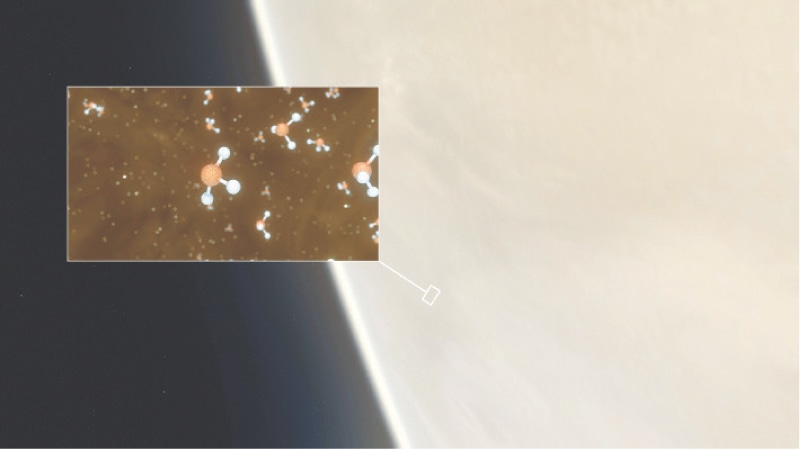
PARIS: The atmosphere of Venus contains traces of phosphine gas — which on Earth is associated with living organisms — scientists said on Monday, in fresh insight into conditions on our nearest planetary neighbour.
Conditions on Venus are often described as hellish with daytime temperatures hot enough to melt lead and an atmosphere comprised almost entirely of carbon dioxide.
A team of experts used telescopes in Hawaii and Chile’s Atacama Desert to observe Venus’ upper cloud deck, around 60 kilometres (45 miles) from the surface.
They detected traces of phosphine, a flammable gas that on Earth occurs from the breakdown of organic matter.
Writing in Nature Astronomy, the team stressed that the presence of phosphine alone did not prove the presence of life on Venus.
However, as the clouds swirling about its broiling surface are highly acidic and therefore destroy phosphine very quickly, the research did show that something was creating it anew.
The researchers conducted several modelling calculations in a bid to explain the new phosphine production.
They concluded that their research provided evidence “for anomalous and unexplained chemistry” on Venus.
Alan Duffy, an astronomer from Swinburne University and Lead Scientist of The Royal Institution of Australia, said it was “one of the most exciting signs of the possible presence of life beyond Earth I have ever seen”.
He cautioned however that while it was tempting to believe that the phosphine was produced by lifeforms, “we have to rule out all possible other non-biological means of producing it”.
Venus is a subject of intense interest among astronomers. It is so close and of such similar size to Earth that some experts believe it serves as a warning of the dangers of runaway climate change.
Published in Dawn, September 15th, 2020