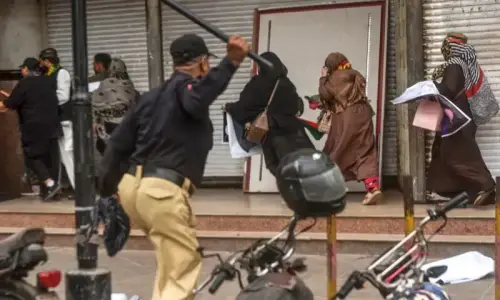
THE message to women is clear: silence is your best option. In public, in the ‘sanctity’ of the home, wherever you face gender-based violence, silence is the best option.
The gang rape of a young woman on the Lahore-Sialkot motorway has once again underscored why it is so difficult to contain the scourge of sexual violence in Pakistan. Despite the public outpouring of sympathy for the victim, who along with her children has endured an ordeal she may never be able to put behind her, the fact is that a deep vein of misogyny runs within this society.
Read: Pakistanis take to the streets to demand justice and structural reform after motorway gang-rape
The Lahore CCPO Umer Sheikh’s reprehensible victim-blaming springs from this very mindset. When the city’s top cop says in so many words that women who step outside their homes after a certain hour cannot expect to be protected from predatory men, he does more than disgrace his office. His casual sexism reinforces a patriarchal order premised on controlling women, not just in the public sphere but in the domestic one as well. Moreover, Mr Sheikh also let slip identifying details about the rape survivor, flouting the most basic protocols about the handling of sexual violence cases.
This is precisely why only a small minority of women take the ‘risk’ of reporting crimes like rape or domestic violence. Most would balk at the prospect of being quizzed by boorish, insensitive cops who are the product of a society where moral policing of women is almost a national pastime. Suggestions that they somehow ‘asked for it’ — classic victim-blaming in which the onus is on the woman to prove why she shouldn’t have expected violence to be visited on her — compounds their suffering. The fight to bring the perpetrators of gender-based violence to book is often thus lost at the very first hurdle.
Some urgent measures are called for. Gender sensitisation should be an integral part of police training, rather than constituting the occasional workshop. Moreover, personnel who are incapable of reflecting on their prejudices and modifying their behaviour accordingly must be held accountable; misogyny is a badge of shame, and no police officer should be made to forget it.
The process of evidence gathering, including medical examination and obtaining the victim’s statement, must be geared towards avoiding further trauma. In a positive development, the humiliating and discredited ‘two-finger’ virginity test — upon which are based often demeaning conclusions about rape victims’ character that are then used against them in court — may finally be abolished in Pakistan.
Finally, the police in this country needs to stop resembling a boy’s club. The recruitment of women in law enforcement must be further stepped up and more of them promoted to senior positions. Victims of gender-based violence should have access to female police officers especially trained to handle this type of crime. Pakistani women deserve to feel safe in their country.
Published in Dawn, September 13th, 2020