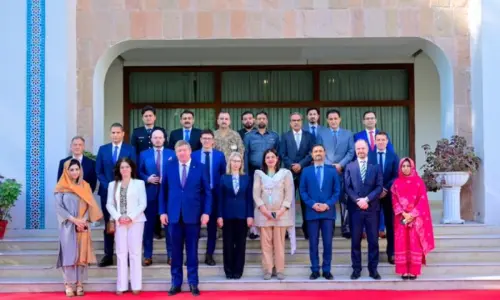
THE news that the Taliban delegation visiting Islamabad has had productive discussions with the Pakistani side led by Foreign Minister Shah Mahmood Qureshi has raised expectations of an early start to the intra-Afghan dialogue.
In fact, speaking to the media after the talks, Mr Qureshi said he was hopeful that the intra-Afghan talks would start soon and expressed optimism for progress in the near future despite problems and the presence of spoilers. He was assisted in the talks by DG ISI Lt-Gen Faiz Hameed while the Afghan Taliban were led by Mullah Abdul Ghani Baradar, director of the Taliban’s Doha-based political office.
The intra-Afghan talks are facing some delays on the issue of release of prisoners. While both sides had agreed to the release, last-minute hitches are causing concern. A delay increases the chances of mishaps and incidents of violence flaring up and damaging the delicate situation.
President Donald Trump has announced a major drawdown of US troops in Afghanistan before the November US presidential elections which means the timeline for talks between the Afghan government and the Taliban is a tight one.
Pakistan has played a constructive role in bringing the Taliban to the negotiating table and Washington has acknowledged this role. The foreign minister’s optimism suggests sufficient headway has been made in the Islamabad talks in terms of the Taliban’s approach to finding a way out of the prisoner release impasse.
The key challenge now is to bring the two Afghan sides together to start negotiating a power-sharing agreement. This will be a long, arduous process with obstacles that may threaten talks at any point. Therefore, it would be important for both sides to ensure that violence does not break out and derail talks. At the same time, major stakeholders such as Pakistan and the US will need to keep engaged at every stage of these negotiations in order to ensure hurdles are crossed without prospects of the process breaking down.
After Afghanistan, no other country has a bigger stake in peace in the war-torn country than Pakistan. It goes to the credit of the Pakistani leadership that it has steered the Taliban to the negotiating table and managed a terse relationship with the Kabul government well. Afghanistan now has a genuine shot at a peaceful settlement of the decades-long conflict.
Islamabad and Washington should now lean on both sides to fulfil the obligations agreed upon earlier. The last batch of prisoners need to be released and dates for talks firmed up. The longer this uncertain situation prevails, the greater the chance of a spoiler event happening.
It is hoped that some firm commitment would have been made by the Taliban in their talks at the Foreign Office and that this momentum would be matched by President Ashraf Ghani. The Trump administration needs to prod Kabul to fulfil its commitments as soon as possible.
Published in Dawn, August 27th, 2020