Can NAB bypass Constitution in making appointments, asks SC

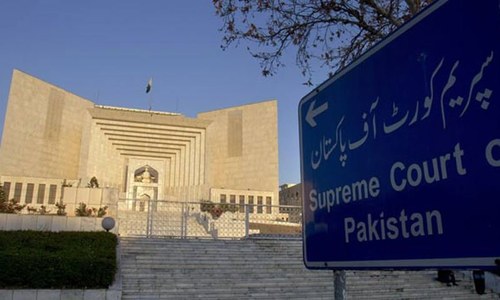
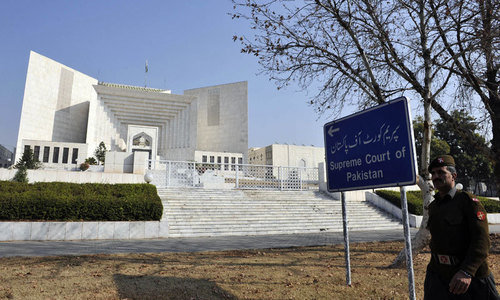
ISLAMABAD: The Supreme Court has asked if the National Accountability Bureau (NAB) can bypass constitutional provisions in making appointments in the bureau under a subordinate legislation.
“On the next date of hearing, the prosecutor general NAB is required to satisfy the court whether under the subordinate legislation, the mandate of the Constitution under Articles 240 and 242 can be bypassed in making appointments,” said a three-page order issued by a two-judge SC bench consisting of Justice Mushir Alam and Justice Qazi Faez Isa.
The directive came on an appeal filed by Muhammad Nadeem seeking post-arrest bail in a case registered against him on Feb 19, 2020 under the Telegraph Act at the Aabpara police station in Islamabad.
During the hearing, the appointment of NAB’s Rawalpindi Director General Irfan Naeem Mangi was questioned by Justice Isa and the court was told that he was an engineer. Subsequently, an order was issued later asking under what power and authority the NAB director general was functioning.
The court was informed that Mr Mangi was appointed by the NAB chairman in exercise of powers under Section 28(g) of the National Accountability Ordinance (NAO) 1999.
Bureau’s prosecutor general told to satisfy apex court on the matter at next hearing
Section 28(g) reads: “Notwithstanding anything to contrary contained herein or in any law for the time being in force, the chairman NAB, shall not be required to consult the Federal Public Service Commission for making appointments and on matters relating to the qualifications of persons for such appointments and methods of their recruitment and the qualifications for the appointments and methods of recruitment shall be such as he may by rules prescribe.”
The perusal of clause (g), read with Section 34 of the NAO, reveals that prima facie such powers are to be exercised in the manner as provided for under the ordinance of 1999, and the NAB chairman is required to make rules for carrying out the purposes of the ordinance 1999, but the court has been informed that no such rules have been made till date.
On the other hand, Article 240 of the Constitution deals with the appointment to the service of Pakistan and spells out the condition to make such appointments through the Public Service Commission. Likewise, Article 242 of the Constitution states that appointments in the service of Pakistan will be made through the Public Service Commission.
Consequently, the Supreme Court directed its office to deal the present case as a fresh suo motu and fix it before the bench for consideration of the points highlighted. Since the point needed interpretation of the Constitution and the law, notice should also be issued to Attorney General Khalid Jawed Khan to assist the court in the matter, the order said.
The court regretted that the NAB prosecution had not learnt from the earlier lapses rather it aggravated the perception of the incompetence of the officers. The court also deplored that the statement of Irfan Mangi — a star witness in the case of impersonation — had neither been recorded nor had any other incriminating evidence so far been collected.
Earlier also, the order said, Muhammad Nadeem, who had impersonated DG Mangi, had been extended bail twice on the ground of lack of proper investigation and evidence and same was the position in the case at hand.
Nadeem was allegedly heading a gang operating in Lahore and Karachi, but neither any material was collected nor was any gang or co-accused traced during the investigations, the order said.
Earlier, Chief Justice of Pakistan Gulzar Ahmed, while hearing a case relating to NAB, had also held in an order that the anti-graft watchdog itself was responsible for the delay in deciding corruption references as its officials were not competent.
The chief justice had also regretted that the NAB officers did not possess enough expertise to conduct proper enquiries/investigations and it seemed that no measure was in place on the basis of which such enquiries/investigations were examined. He observed that the NAB officers conducted faulty enquiries or investigations which then turned into a reference — a reference which in turn became a non-starter in accountability courts.
The Supreme Court regretted that delays in deciding cases were caused because NAB did not have proper supporting material before finalising a reference, which was essential to take the case to a logical conclusion.
Published in Dawn, August 8th, 2020