New shipping policy unveiled to attract private sector


 1
1


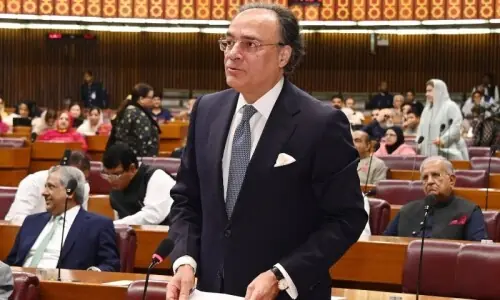
ISLAMABAD: Federal Minister for Maritime Affairs Ali Haider Zaidi on Friday unveiled a new shipping policy offering incentives for establishment of local shipping lines and said the nationalisation policy of 1972 destroyed the country’s vibrant shipping industry.
“Under the impact of new shipping policy, very soon we will see registration of three to four local shipping companies and it will also help job security of our seafarers,” Mr Zaidi said, lauding the role of the Ministry of Commerce in finalising the policy.
The minister expressed these views while addressing a news conference along with Adviser to the Prime Minister on Commerce Abdul Razak Dawood.
Mr Zaidi said the government built upon the Marine Policy of 2000 and some amendments were made to it. “The target is to invite the private sector to shipping business and the state will protect them as it is being done globally. Till the year 2030, customs duty has been abolished for all ships to be registered in the country so that they become national flag carriers,” Mr Zaidi said.
Minister says 1972’s nationalisation policy destroyed shipping industry
Other incentives in the policy include exemptions of sales tax and income tax on all income of the registered ships.
“The most important incentive for the Pakistani flag carriers would be the first berthing right, which is an international practice. It saves a lot of money for the ships if unloading is not delayed,” the minister said.
According to him, another relief offered to the private sector is reduction in gross tonnage tax (GRT) if the shipping companies agree to accept freight charges in Pakistani rupee instead of green buck. This incentive has been approved in the finance bill of 2020-21.
Under the new marine policy, the State Bank of Pakistan has allowed the long-term finance facility (LTFF) for ships and vessels, which was earlier available to exporters.
The minister said: “This will help the investors buy all floating vessels, including tug boats, dredger, cargo vessels and even the fishing boats, to obtain the long-term borrowing at three per cent from the banks.
“This will also help our fisheries sector that has the potential of more than $2 billion, but fish and seafood exports are currently limited to only $450m annually. This will eventually help us upgrade the fishing sector to deep-sea fishing sector,” he added.
Highlighting the importance of the shipping industry and ports for a country like Pakistan that has vast coastline, the minister said that after the independence, there was not a single seafaring ship in Pakistan and the Quaid-i-Azam had called the father of Ardeshir Cowasjee, Rustom Fakirjee Cowasjee, who was a businessman in merchant shipping, and requested for help.
“At that time, ships were not registered in Karachi as they used to be registered in Bombay and Calcutta; the first ship registered in Pakistan was named ‘Fatima’ by Mr Cowasjee,” the minister recalled.
He said a strong shipping industry developed in Pakistan but it went to near collapse after the nationalisation policy of 1972, with the result that only the public sector Pakistan National Shipping Corporation (PNSC) remained in business to date.
“While the private sector recovered in areas of business, the shipping side remained subdued for the private investors,” he said, adding that “even now those Pakistanis who own ships do not get them registered in the country”.
The minister said that currently Pakistan spent around $5 billion annually in terms of freight charges for all foreign trade and PNSC’s share was only five per cent of it, as the national company was mostly focused on the import of petroleum products only.
“We import a large number of commodities and there are exports from Pakistan too,” he said.
Mr Dawood said Pakistan would soon have a transhipment policy. There were 842 ships in India, 347 in Bangladesh and 40 in Sri Lanka, but Pakistan had only 11 ships. Even Iran despite the prolonged sanctions had 100 ships, he added.
Published in Dawn, August 8th, 2020