Covid-19 cases could reach 1.2 million by end July, warns Asad Umar

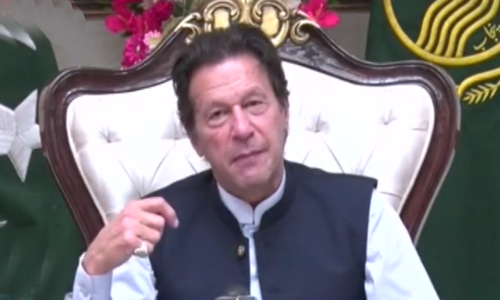
Minister for Planning, Development and Special Initiatives Asad Umar on Sunday issued a stark warning regarding the current trajectory of the spread of Covid-19 in the country, saying that the confirmed cases of the novel coronavirus could double by the end of this month and reach 1 million to 1.2m by the end of July.
He shared these projections during a press conference in Islamabad.
"We're in mid-June and our [confirmed] cases have reached approximately 150,000. It saddens me to say that based on our current trajectory [of spread], experts have projected that our cases could double by the end of June," he said, adding that Pakistan's confirmed Covid-19 case tally could even reach 1m to 1.2m by end July.
Umar noted, however, that these projections were neither predictions nor a certainty. He said that the "good news" is that the potential spike in confirmed cases was avoidable, provided the government and the people work together to stop it.
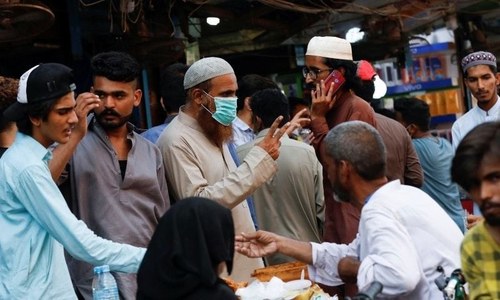
Urging people to "get serious", Umar highlighted the importance of wearing face masks and practising social distancing to curb the spread of the novel coronavirus.
Wear face masks
"Research [around the world] has indicated that wearing masks is a verified way of curbing the spread of Covid-19 — by up to 50 per cent," he said, adding that the National Command and Operation Centre [NCOC] had recommended that face masks be worn by everyone in public places.
"We are seeing many people wearing masks but sadly we've seen many more not wearing one. If you want to defend yourself and your loved ones, please wear masks. It's as simple as that," he added.
Umar pointed out that the government had issued guidelines regarding social distancing requirements that people should follow. "This [practising social distancing] is the simplest way to ensure that businesses remain open and the wheel of the economy keeps turning."
He warned that if people failed to follow preventive guidelines issued by the government, it would result in "people losing their livelihoods".
"We're now at the stage where we will start taking administrative action against those who aren't wearing masks or maintaining social distancing," he added.
Smart lockdowns
Endorsing Prime Minister Imran's decision to impose "smart lockdowns" in virus hotspots around the country as opposed to a complete lockdown, Umar said that "the world is now beginning to realise that imposing a complete lockdown will cause the economy to crumble".
"We have to enforce smart lockdowns in hotspots because this way we can stop the spread in areas that are witnessing outbreaks and at the same time protect jobs and livelihoods by not imposing complete lockdowns," he said.
The prime minister had said yesterday that a strategy of "smart lockdowns" will be implemented, whereby strict adherence to standard operation procedures (SOPs) will be ensured to curb the spread of the novel coronavirus.
"After analysing with my Punjab team, [we've decided that] we will not impose a lockdown but will impose selective lockdowns — trace and seal hotspots," he had said, adding that the country's administration and police were not in a position to take "such a huge burden of a complete lockdown".
'Govt aims to conduct 100,000 Covid-19 tests daily by end of July'
Umar said that the government aims to conduct 100,000 Covid-19 tests by the end of July.
"We were only testing 500 people at the start [of the pandemic]. Now we are able to conduct 30,000 tests per day and the NCOC has decided to take our [testing] capacity to more than 100,000 tests per day by the end of July," he said, adding that the government is constantly increasing its testing capacity.
He urged people to "show discipline" and follow preventive measures. "If our actions can cause spikes, our actions can also reduce the spread of the virus," he concluded.