Lockdowns don’t violate Federal Legislative List, SC told


 1
1


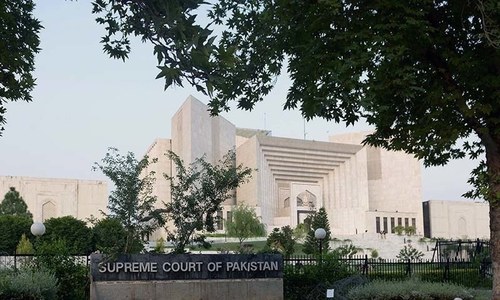
ISLAMABAD: The Punjab government on Saturday informed the Supreme Court that enforcement of partial lockdowns under the Punjab Infectious Diseases (Prevention and Control) Ordinance 2020 was not in violation of the Federal Legislative List (FLL) of the Constitution rather it was aimed at securing public health, public order and prevention of a pandemic of an unparalleled magnitude.
It was, in fact, the federal government that had encouraged the provinces to undertake such legislation that may incidentally have a bearing on certain subjects and areas not falling within the provincial legislative competence, the Punjab government argued in a report, explaining that the dominant object of law was to arrest Covid-19 and to protect and secure the right to health — concomitant right of the right to life under Article 9 of the Constitution.
Additional Advocate General for Punjab Shan Gul furnished the report in response to the Supreme Court’s questioning of the competence of the provinces to enact legislation for shutting down business activities that adversely impacted taxation activity of the federal government in terms of the Federal Legislative List.
Punjab says Centre encouraged provinces to undertake legislation that may have bearing on subjects not falling within provincial legislative competence
A five-judge bench of the Supreme Court, headed by Chief Justice Gulzar Ahmed, will resume the hearing of the case on Monday (May 18).
Justice Mushir Alam, Justice Sardar Tariq Masood, Justice Mazhar Alam Khan Miankhel and Justice Qazi Muhammad Amin Ahmed are other members of the bench. Justice Mushir Alam and Justice Sardar Masood had been added in the bench due to unavailability of Justice Umar Ata Bandial and Justice Sajjad Ali Shah.
Besides the Punjab government, the Khyber Pakhthunkhwa, Sindh and Balochistan governments as well as the federal Ministry of Health filed similar reports.
Justifying the imposition of partial lockdowns, the Punjab government argued that the National Command and Operation Centre (NCOC) at one of its meetings had decided to impose partial lockdown on business and trade for ensuring social distancing among masses in a bid to arrest the spread of the Covid-19. This was done in the garb of Entry No 19 of Part I of the Fourth Schedule of the FLL, the report explained, adding both federal and the provincial governments were stakeholders in NCOC.
“It is, therefore, not as if the province is doing on its own rather a meaningful and consultative process between the federation and the provinces resulted in the promulgation of the provincial ordinance 2020 for imposing partial lockdown,” the report explained.
Moreover, the Epidemic Disease Act 1897 — a federal law on pandemic/calamities — itself vests the provinces with necessary authority to put in place temporary regulations for controlling the spread of epidemics.
This is exactly what the provinces did and therefore the announcement of partial lockdown by the Punjab province with respect to trade and business was not only justified in the context of the legislative competence but was also backed and supported by an existing federal law, the report stated.
Thus the action had unanimous backing of the federation and the provinces as the NCOC had approved such a course of action, it said, adding that the action was initiated in a holistic manner and was across the board.
The provinces did not exceed their legislative competence by imposing lockdowns, rather they showed regard and respect for the mandate of the Constitution, the report argued.
Besides the element of complete ban on inter-provincial movement of people had been diluted by means of allowing travel by rickshaw and Chinghcee, but for other larger public transport vehicles, a meeting of the transport sector representatives with the government had been arranged.
Referring to the requirement of seeking consent of the President before enacting a provincial legislation, the report explained that the assent of the Governor in terms of Article 116 of the Constitution condones the failure of the provincial government to obtain consent from the President as required by Article 151(4) of the Constitution.
About the allegations of irregularities in the Zakat Fund, the Punjab government explained that the main objections of the Auditor General of Pakistan was about the violation of rules and procedures, minor errors and non-production of the record. But the auditor general had also admitted that there was no case of fraud, embezzlement, thefts and misuse of public resources, the report explained.
On May 2, the AGP had disclosed that irregularities worth Rs3.67 billion were unearthed when a total of Rs5.96 billion funds had been audited for the Zakat Department and Pakistan Baitul Mal for the year 2019-20.
The AGP had explained that in the Zakat Fund, a sample audit of 13 per cent (Rs961 million) of the total budget of Rs7.38 billion was carried out. Out of the Rs961 million audited, irregularities worth Rs574 million were detected.
Similarly, the annual budget of Pakistan Baitul Mal was Rs5 billion, of which it conduct the audit during the audit year 2019-20 and found out irregularities to the tune of Rs3.1 billion.
The irregular expenditure in the case of Baitul Mal was 62 per cent of the total funds though Rs475 million was also recovered, the AGP had said.
Meanwhile, the Sindh government said that due to alarming growth of Covid-19 cases, the provincial government had been issuing necessary advisories to the general public from time to time to take precautionary measures. The provincial government is making all-out efforts including preventative and curative measures to enhance the capacity of hospital-based isolation / quarantine centres, ICUs, Lab Testing Capacity and human resource and their trainings to cope up with this pandemic.
Published in Dawn, May 17th, 2020