Pompeo in Israel for West Bank annexation talks amid new bloodshed

JERUSALEM: US Secretary of State Mike Pompeo visited Israel on Wednesday for talks with leaders on plans to annex swathes of the occupied West Bank, which has been rocked by two days of deadly violence.
Pompeo and Prime Minister Benjamin Netanyahu, meeting in Jerusalem, also voiced fresh condemnation of their common foe Iran, accusing the Islamic republic of promoting terrorism during the coronavirus pandemic.
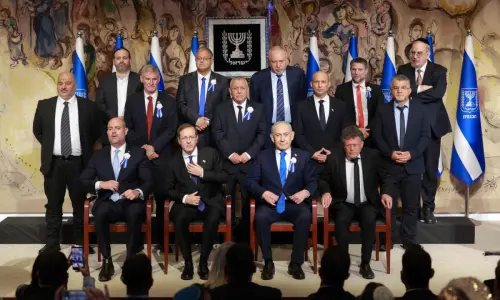
The visit by US President Donald Trump’s top diplomat comes a day before Netanyahu’s unity government with rival-turned ally Benny Gantz was to be sworn in, ending a year of political paralysis.
It also coincided with an upsurge in violence in the occupied West Bank.
Israeli troops shot dead a 15-year-old Palestinian in a refugee camp near the flashpoint city of Hebron on Wednesday, a day after a Palestinian stone-thrower killed an Israeli soldier during an arrest operation near Jenin, the army’s first fatality of the year.
Pompeo wore a red, white and blue face mask as he arrived on his first foreign trip in nearly two months.
He also met Gantz, the incoming defence minister, to discuss Trump’s controversial Middle East peace plan, which gives a green light for Israel to annex Jewish settlements and strategic areas of the West Bank.
Netanyahu and Gantz are set to launch their government on Thursday, having faced off in three inconclusive elections in less than a year before agreeing to a three-year power-sharing administration.
Netanyahu, a right-winger in office since 2009, will serve as premier for 18 months with Gantz as his alternate. The two will swap posts midway through the deal.
Their coalition agreement says the government can from July 1 begin considering to implement Trump’s plan.
The Palestinians have rejected Trump’s proposals and cut ties with his administration in 2017 over its pro-Israel stance.
Their chief negotiator Saeb Erekat said Pompeo’s team had not reached out ahead of the visit.
“The Trump administration is collaborating with Israel in its annexation plan in what is both an attempt at burying the rights of the Palestinian people as well as a blatant attack on a rules-based international system,” he said.
Israel has controlled the West Bank since seizing it in the Six-Day War of 1967.
Nearly three million Palestinians live in the territory alongside more than 400,000 Israelis residing in settlements that are considered illegal under international law.
For the Palestinians and much of the international community, Israeli annexations would sink any hope of a two-state solution to the conflict.
Former US president Barack Obama’s ambassador to Israel, Daniel Shapiro, said that he believes the “Trump administration very much wants this annexation to happen.” He said it was less concerned about the logistical complications but wanted to ensure its staunchly pro-Israel voters, including evangelical Christians and conservative Jews, were energised ahead of the November presidential election.
Netanyahu may be tempted to move quickly in order to help Trump in November and ensure annexation is a done deal before a possible unfavourable change in the White House, Shapiro noted.
Published in Dawn, May 14th, 2020