BOTH houses of parliament have returned to work.
Unfortunately, it seems that the long break away from the legislature has done little to diminish the lawmakers’ enthusiasm for blame games which are witnessed as much outside as within the august halls.
On Monday, the National Assembly met after nearly two months for a pre-budget sitting to discuss the government’s response to the coronavirus pandemic.
The session will continue till Friday before the Assembly reconvenes for the budget session after Eid.
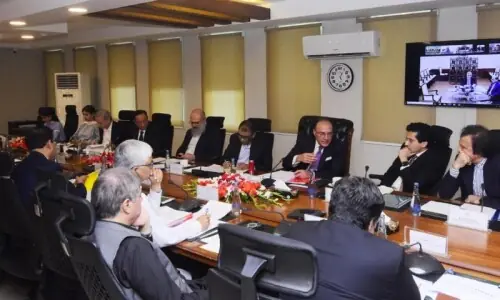
Unlike the British House of Commons, which recently chose to convene a hybrid session, allowing only 50 MPs out of a total of 650 inside the chamber while accessing the input of others through videoconferencing, our elected representatives had rejected a proposal to organise a virtual session, citing constitutional and technological reasons.
Their insistence on meeting in person at a time when infection rates are rising indicates their aversion to changes that democracies across the world are willing to consider.
True, the Assembly administration had taken social-distancing measures, some routine rules were suspended and political parties allowed their members to use their personal discretion when it came to attendance.
The presence of bureaucrats and journalists was also restricted.
Yet, a number of MNAs ignored social-distancing guidelines, shook hands and hugged each other despite warnings from the chair.
Many did not wear masks or gloves.
It makes no sense then for the opposition, especially the PML-N, to not budge from its position and make room for hybrid or virtual sittings at this time.
Their fear that the government could misuse a hybrid or virtual system to curtail the opposition’s role in future stems from a deep-rooted mistrust between the two sides.
No doubt, it is necessary for parliament to function even in these times.
The opposition in a democracy has a very important role to play by questioning and debating government policies and actions.
However, one expects more flexibility from both sides in the face of new, perilous realities.
With the National Assembly speaker and some others from the parliamentary staff having tested positive for Covid-19, great care should have been exercised before convening the session.
Had the opposition agreed to a virtual or hybrid sitting, its leader Shahbaz Sharif and Prime Minister Imran Khan, as well as some others could have participated in a meaningful debate.
All is not lost.
The treasury and opposition can still use this session to reach an agreement on parliamentary sittings until the threat is over.
We know that many MNAs such as Minister Chaudhry Fawad Hussain who did not attend Monday’s session genuinely feel there is an unnecessary risk involved.
An agreement at the national level will be an incentive for the provinces to also hold virtual/hybrid sessions.
After all, it is as important to discuss provincial Covid-19 policies as the federal response to the crisis.
Published in Dawn, May 13th, 2020