LAHORE: The Pakistani prison system from a disability perspective was discussed in a webinar by Justice Project Pakistan director Sarah Belal and Khalid Sherwani from the Network of Organisations Working for People with Disabilities, Pakistan.
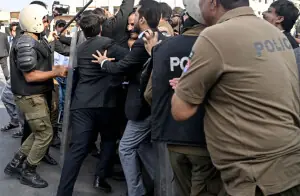
Ms Sherwani mentioned the case of Salahuddin who was a victim of police brutality, proving that no one had understood his mental illness.
“There is very little cognizance and understanding about the disabilities issue within the actors of the criminal justice system - the police, lawyers, judiciary and jail officials,” said Ms Belal. “Physical disabilities are visible so people can still recognize the needs of the person, but with mental health, there is a spectrum, and it depends on how much the illness has manifested. This kind of disability is difficult to diagnose and understand and we need more knowledge on part of these actors.”
But there were few resources to deal with this. Also, were rights and protection being given to disabled persons under laws? If not is there any accountability of it?
The Sindh Mental Health Act, and the Sindh Personal Disabilities Act are both functional, said Mr Sherwani.
Ms Belal said that the 18th Amendment allowed both federation and provinces to take a lead on any issue. However the Punjab Mental Health Act was based more on the ordinance, and it is also not being fully implemented.
“There is no dearth of law in Pakistan but we need political will. Pakistan must remember it is a signatory of several conventions and treaties, and a member state of UN. It has also signed and ratified a convention on persons with disabilities.”
COVID-19 & PRISONERS: After the coronavirus outbreak, jail overcrowding in Pakistan has become an issue. “With disabled prisoners their motor functions may be impaired, and they may suffer from mental health issues, not being able to care for themselves especially regarding hygiene. In an overburdened and overcrowded prison system this is difficult to manage,” she said.
In the Mandela Rules, it is clearly stated that all prisoners worldwide have the right to receive the same standard of medical services within the prison that people are receiving outside.
“However people with disabilities need extra care which cannot be provided inside jail,” she said.
According to government statistics there are 2,100 prisoners with physical ailments, and 600 with mental illness – which according to us is grossly small number – are vulnerable to outbreak of any kind.
Perhaps the pandemic is an opportunity to change the criminal justice system,” she said.
COURTS FOR DISABLED PERSONS: Meanwhile, Sindh’s Mental Health Act of 2018 has a provision for special courts to deal with persons of disabilities, which was passed in 2019 and now districts have been issued notifications.
Mr Sherwani questioned if there was a need for special courts.
ABDUL BASIT’S CASE: The panelists discussed Abdul Basit’s case. He was sentenced to death in a murder case. When he went to prison in Faisalabad, riots broke out in 2009 or 2010.
The jail superintendent put many of the prisoners in the ‘Punishment Ward’ which is basically solitary confinement, with zero hygiene, where Basit contracted tubercular meningitis and upon his release was found lying there unconscious. He stayed in a coma for many days but he lived and was found to be paralysed from neck down.
Now he lies on the jail floor, has a colostomy bag and is dependent on the jail staff for everything. He has served more than a life sentence. Later on, a ramp was built for disabled prisoners – mainly for Basit, because they thought they would hang him from his wheelchair. In 2016, his execution did not happen - it was stopped five minutes before. That was in 2016.
Panelists said that 10 per cent of prisons in Punjab do not have ambulances, eight posts for medical officers are lying vacant and 58 posts for psychologists are vacant.
Published in Dawn, April 30th, 2020