0
0
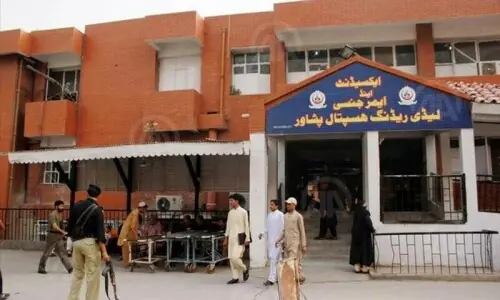
PESHAWAR: The Peshawar High Court on Tuesday issued notices to the attorney general for Pakistan and Khyber Pakhtunkhwa advocate general for response to a petition seeking the court’s orders for striking down a recent presidential ordinance, which curtailed major powers of the National Accountability Bureau (NAB).
A bench consisting of Chief Justice Waqar Ahmad Saith and Justice Mohammad Nasir Mehfooz fixed Mar 5 (Thursday) for next hearing after holding preliminary proceedings and asked the attorney general, advocate general, NAB prosecutor general and some other respondents to respond to the petition on that date.
The petition is filed by around 200 people, mostly belonging to Nowshera district, who seek the court’s orders to declare ‘any act done on the strength of the impugned ordinance, which was promulgated by the president of Pakistan on Dec 28, illegal, void and in conflict with different provisions of the Constitution’.
They prayed the court to direct the NAB to proceed with the inquiries/ investigations and trials under the original National Accountability Ordinance (NAO), 1999.
Advocate Shah Faisal Ilyas appeared for the petitioners and contended that almost 90 per cent of the NAB cases would automatically come to an end and loss to public exchequer would occur in financial matters, too. He stated that through this ordinance money launders had been facilitated.
Petitioners have challenged presidential ordinance that curtailed accountability body’s major powers
He requested the court to suspend operation over the said ordinance till final disposal of this petition. The bench observed that as vires of the law were challenged and it was an important matter, therefore, would fix it for a short date.
The bench directed an additional attorney general, an additional advocate general and a NAB’s prosecutor, who were present in the courtroom, to accept the notice on behalf of the respondents.
Shah Faisal Ilyas argued that the offence of the misuse of authority was now almost abolished in the National Accountability Ordinance, 1999, by adding the words ‘materially benefitted’ with it.
He said the offences of illegal schemes and destructive projects designing authorities are also excluded from the column of offences and giving opinion, reports etc. by the authority through which if loss occur to public exchequer could no longer be an offence.
He cited several petitions decided by the high court related to misuse of powers in appointments in different government bodies specially in Nowshera.
In those petitions, the court had ordered the NAB to conduct inquiries.
The counsel contended that amendments to the NAO 1999 through the National Accountability (Amendment) Ordinance, 2019, had rendered many of the high court judgments and pending petitions infructuous.
The petitioners said several inquiries and investigations were stopped and trials vitiated proving that the impugned ordinance is against the basic anti-corruption and anti-corrupt practices law.
The respondents in the petition are the president and the prime minister through their respective principal secretaries, NAB chairman and its KP director general, attorney general for Pakistan, federal secretaries of law and interior divisions, and provincial law secretary and advocate general.
The counsel said amendment to Section 9(a) (ix) (x) and (xi) of the NAO was made wherein for sake of misuse of authority, financial gain of transaction is made part and parcel otherwise the misuse of authority would be no offence under the law.
He stated that a reference had already been pending before the accountability court in Peshawar against ex-tehsil nazim Nowshera, Ahad Khattak, who is the nephew of defence minister Pervez Khattak, and on the strength of the said ordinance the accused has now filed an application under Section 265-K of Code of Criminal Procedure seeking his acquittal before conclusion of his trial.
Furthermore, he stated that after promulgation of the impugned ordinance, inquiries in all mega projects such as BRT (Bus Rapid Transit), Malam Jabba scandal, etc, would be stopped.
He contended that after those amendments were made, very few cases would be left with the NAB and therefore, the body would be only a burden on national exchequer.
He claimed that the ordinance was basically made for the protection of all those political and bureaucratic entities that are on same footing with the government.
Published in Dawn, March 4th, 2020