Turkey loses two soldiers as Syrian forces step up offensive
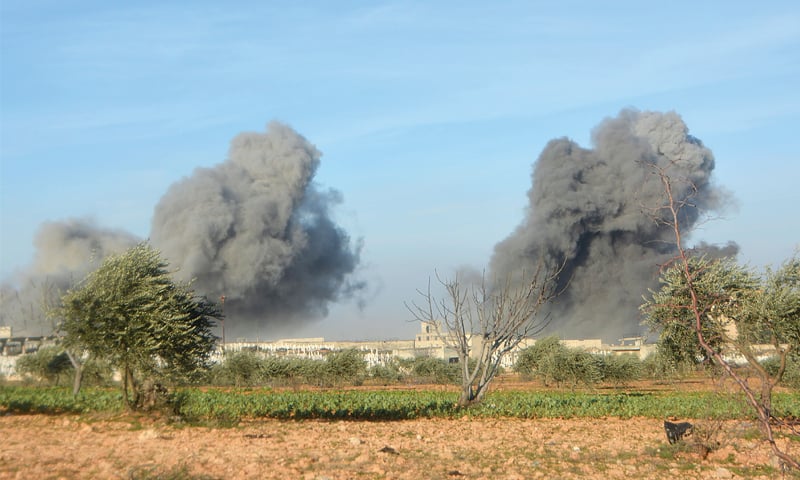

ANKARA: Two Turkish soldiers were killed on Thursday in an air strike in northwestern Syria, Turkey said, after an attack by Ankara-backed opposition forces that targeted Syrian government troops. The deaths came after the Turkish president threatened to expand his nation’s involvement in Syria if another one of his troops were hurt.
At least 15 Turkish soldiers have been killed in Syria this month amid a crushing offensive by Syrian President Bashar Assad’s forces aimed at recapturing remaining opposition-held areas in the region.
Intent on halting the advance, Turkish President Recep Tayyip Erdogan had vowed Feb 12 to take military action everywhere in Syria if another Turkish soldier was killed or wounded.
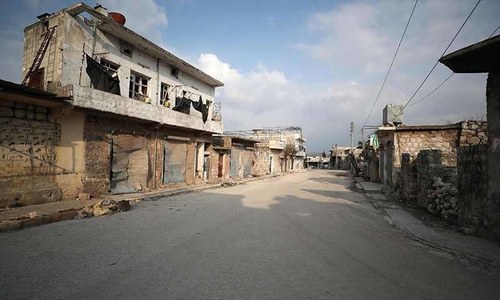
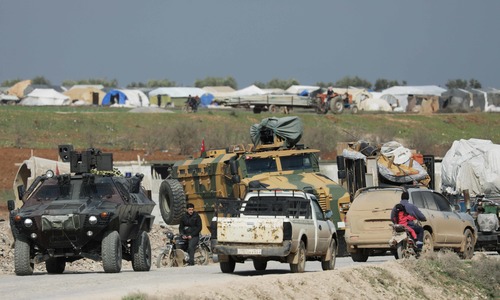
The multiple front offensive has triggered the biggest single wave of fleeing civilians in Syria’s nine-year war, displacing nearly one million people who have rushed toward the Turkish border and are now sheltering in tents or sleeping rough in harsh winter weather.
It has also risked completely shattering a fragile cooperation between Ankara and Moscow, which back opposing sides of the Syria war. Ankara has sent thousands of soldiers to northwestern Syria to try to stem the Syrian government advance on the province near the Turkish border, leading to the repeated flare-ups.
Thursday’s exchange marked a serious escalation that risks growing into a full-blown conflict between Turkey and Syria. Erdogan has also called on Assad’s forces to retreat from Idlib or face an imminent Turkish attack.
The exchange began after opposition fighters shelled Syrian government forces and entered the village of Nairab, which Assad’s forces had captured Feb 3, the Turkish Anadolu agency said.
The Russian military said the militants’ actions were supported by Turkish artillery fire, which allowed them to break through the Syrian army’s defenses. Four Syrian soldiers were wounded in the Turkish shelling, it said.
At the Syrian military’s request, Russian Su-24 bombers then struck the militants to prevent them from advancing and allowing Syrian government forces to successfully repel all attacks, the military added.
It was not immediately clear whether it was the Russian air strikes that killed the two Turkish soldiers and injured five others.
Fahrettin Altun, a top aide to Erdogan, said the attack was carried out by Syrian government forces. On Twitter, he wrote: The blood of our martyrs won’t be left unaccounted for.
The Turkish Defence Ministry tweeted that as many as 50 Syrian government soldiers were killed and that five tanks, two armoured personnel carriers and other equipment were destroyed.
Turkey and Russia have closely coordinated their moves in recent years in Idlib province. Turkey maintains observation posts in northern Syria that were set up to monitor a 2018 cease-fire agreement with Russia.
The truce collapsed in late 2019, leading to the current Syrian offensive, backed by Russia. Russian officials have said they hold Turkey responsible for the collapse of the ceasefire deal, saying Ankara had not held up its end to rein in militants who continued attacking Syrian and Russian targets.
Ankara sent in thousands of additional troops and armoured vehicles in recent weeks, vowing to halt the government’s advance.
While both Russia and Turkey likely seek to maintain their cooperation across Syria more broadly, growing tensions in Idlib between the two countries threatens to derail that cooperation, said expert Mona Yacoubian, in an analysis for the United States Institute for Peace.
Turkish Foreign Minister Mevlut Cavusoglu said Russian and Turkish delegations would hold more talks on reducing tensions in Idlib province and that the Turkish and Russian leaders could meet too, if needed.
“It is true that at the moment, there are differences in the [two sides] positions,” Cavusoglu told state broadcaster TRT. “The delegations narrowed their differences a bit but are not yet at the point we want to be,” he said.
Published in Dawn, February 21st, 2020