MUNICH: Global defence spending saw its biggest jump in a decade in 2019, driven by the US and China, a study said on Friday, as rivalries and conflicts stoked military investment.
The International Institute for Strategic Studies (IISS) said the four per cent rise, compared to a year earlier, was fuelled by competition between major powers, new military technologies and rumbling warfare from Ukraine to Libya.
Beijing’s military modernisation programme — which includes developing new hard-to-detect hypersonic missiles — is alarming Washington and helping drive US defence spending, the IISS said.
Its annual “Military Balance” report said the increase alone in US spending from 2018 to 2019 — $53.4 billion — was almost as big as Britain’s entire defence budget.
“Spending rose as economies recovered from the effects of the financial crisis, but increases have also been driven by sharpening threat perceptions,” IISS chief John Chipman said, launching the report at the Munich Security Conference.
Both the US and China increased spending by 6.6pc, the report said, to $684.6bn and $181.1bn respectively.
Europe — driven by ongoing concerns about Russia — stepped up by 4.2pc, but this only brought the continent’s defence spending back to 2008 levels, before the global financial crisis saw budgets slashed.
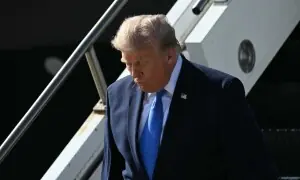
European Nato members have been seeking to increase spending to placate President Donald Trump, who has repeatedly accused them of freeloading on the US.
Trump has railed at European allies, particularly Germany, for not living up to a 2014 Nato pledge to spend two per cent of GDP on defence.
The mercurial president’s anger over spending has fuelled concern about his commitment to the transatlantic alliance, culminating in an explosive 2018 summit where he launched a blistering public attack on Germany in a televised meeting with Chancellor Angela Merkel.
Giving the opening address at the annual security gathering, German President Frank-Walter Steinmeier warned that Trump’s “America First” strategy had shaken up the international order and fuelled insecurity.
“We are witnessing today an increasingly destructive momentum in global politics,” Steinmeier said. “Every year we are getting further and further away from our goal of creating a more peaceful world through international cooperation.”
Key elements of the international order that developed after the Second World War have come under increasing challenge.
Published in Dawn, February 15th, 2020