WHEN Prime Minister Imran Khan laments the absence of a ‘Muslim voice’ in the world, he raises an issue that demands profound analysis.
Speaking to a Malaysian think tank in Kuala Lumpur on Tuesday, Mr Khan referred to disasters that had struck some key Middle Eastern states and regretted the Muslim countries’ inability to forge unity.
How can — let us ask frankly — the Muslim world have ‘one voice’ when there are among the states differences that do not remain confined to the realm of diplomacy but spill over into ferocious multilateral wars?
Precisely at this moment, Muslims are shedding each other’s blood in three countries — Syria, Yemen and Libya — with hundreds of thousands killed, maimed or rendered homeless. Some non-Muslim powers are, indeed, involved in these tragedies, but their roles have been marginal, most of the fighting being done by armies and militant outfits which are Muslim.
In Yemen, two major Muslim oil powers have been locked in a devastating four-year-old war, which has pauperised the Arab world’s poorest country, leaving over 100, 000 dead — 12,000 of them civilians.
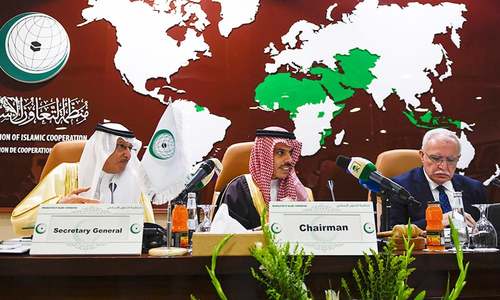
Nothing highlights the extent of mutual hostility more than the Saudi decision to not allow Iran to attend the OIC’s Jeddah moot which was to give its reaction to President Donald Trump’s ‘deal of the century’ hoax on Palestine.
As for India-held Kashmir, not only has the Muslim world — with the exception of Turkey and Malaysia — largely kept its lips sealed, one Gulf country has actually called India’s annexation of the occupied territory its ‘internal matter’, while last year the then Indian foreign minister was invited as the guest of honour to an OIC meeting in the UAE.
While this narration of Muslim frailty is geopolitical, let us not fail to examine the socioeconomic causes which have hindered the emergence of the Muslim world as a powerful force in world affairs.
Today, large sections of Muslim peoples live in a pre-industrial milieu when even many Third World countries have mobilised their national resources to enter the space and digital age. For Muslims, science and technology basically means importing mobile telephones and flying jetliners built in the West.
Muslims have made little effort to take their society forward in education and science, despite the huge financial resources that some Muslim countries command. While very few Muslims have won the Nobel prize, the talented Jewish community has produced nearly 200 Nobel laureates. Thus a community which constitutes a tiny percentage of the world’s population has bagged 20pc of all Nobel prizes, Israel’s tally being 12.
If we want a ‘voice’, then all Muslim countries must first set their house in order, combat poverty and bigotry, create egalitarian and democratic societies and make a determined bid to achieve all-round progress in science. A people who depend on aid hardly deserve a ‘voice’.
Published in Dawn, February 6th, 2020