Conference calls for ‘hydro diplomacy’ to address water issues


ISLAMABAD: Diplomatic channels need to be open for ‘hydro diplomacy’ that can address water management issues between India, Afghanistan and Pakistan, conference participants said on Thursday.
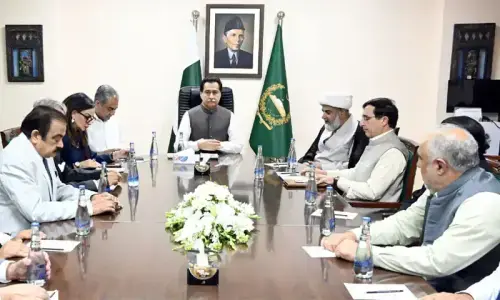
The conference, titled ‘Water Beyond Borders’, was organised by Lead Pakistan. Parliamentarians, diplomats and water experts were among the participants.
Water is a basic human right, Leader of the House in the Senate Shibli Faraz said, but the population explosion, technological boom and high demand for water has led to a global water shortage that is endangering millions.
Mr Faraz said that cooperative ties between water-sharing nations are critical to ensuring adequate access to water, adding that Afghanistan’s push to build dams to store and regulate water was an indirect blow to Pakistan.
He said that if this shared resource was not mutually regulated through political cooperation, it could lead to a drastic shortage.
National conference on ‘Water Beyond Borders’ attended by parliamentarians, diplomats and experts
Despite a treaty, he added, India threatened to block Pakistan’s share of water flowing from its borders. Mr Faraz said this was a violation of international law, but it is an aspect to be aware of and prepare for in case of any conflict.
The availability of water means everything to Pakistan, an agricultural national with the world’s most interconnected irrigation system, he said. He added that this was why the government began the Diamer-Bhasha dam project, which would neutralise external water threats by ensuring adequate water storage in the country.
Mr Faraz said the Indus Water Treaty was a model and a test case that is working between neighbouring countries in conflict with each other.
Adviser to the Prime Minister on Climate ChangeMalik Amin Aslam said that Pakistan’s challenge was to manage its shared water resources.
He said that the Indus Water Treaty needs to be revisited to account for climate change variability and sharing groundwater aquifer.
The total water available is the sum of total run-off water and stored water, Punjab Irrigation Minister Mohsin Leghari explained. He said that storage is decreasing because of increasing siltation in dams, which needs to be addressed.
Former Water and Power secretary Ashfaq Mehmood said the next step after planning a water policy should be continuous monitoring and accountability to ensure that action plans work efficiently.
Senator Usman Kakar told the conference that the provinces have not been given their due share, including when it comes to water distribution. He said that parliament was not being taken into confidence on this critical matter.
“The people of Khyber Pakhtunkhwa do not get their share of water; 92 million acre feet of water passes under the Attock Bridge but Balochistan does not get its share, which is equal to Tarbela Dam,” he added.
Senator Kakar said that the people of Afghanistan already have concerns that Pakistan wants to occupy their water. He suggested Pakistan improve relations with Afghanistan, as Pakistan may otherwise face water issues.
A book on trans-boundary waters was also launched at the event. The book contains the perspective of the public and private sectors, industry and agriculture, academia, international development institutions and local NGOs on water, environment and climate concerns for Pakistan and the Indus region at large.
Published in Dawn, January 24th, 2020