‘Iftikhar Arif among few poets who depicted pain of displacement’
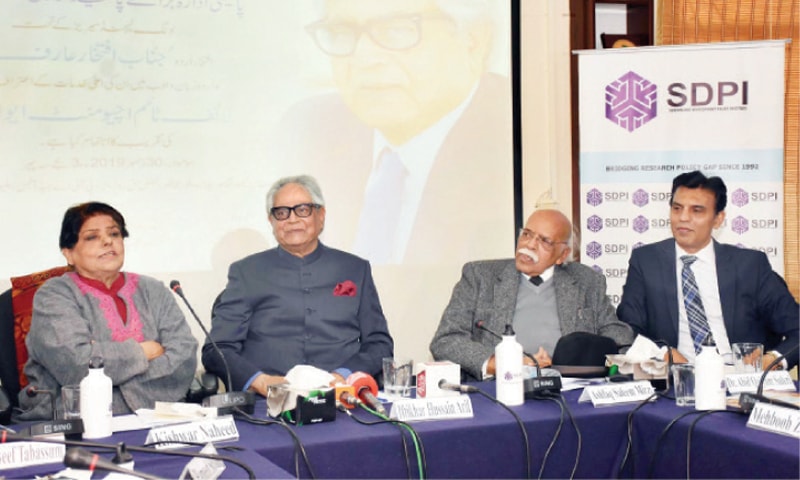


ISLAMABAD: A literary event titled Iftikhar-i-Urdu (Pride of the Urdu Language) was held on Monday to present a lifetime achievement award to Iftikhar Hussain Arif in recognition of his contribution to Urdu language and literature.
The event was organised by the Sustainable Development Policy Institute (SDPI) and attended by Dr Tauseef Tabassum, Kishwar Naheed, Ashfaq Saleem Mirza, Dr Najeeba Arif, Ahmed Saleem and Mohammad Hameed Shahid. Mehboob Zafar moderated the event, while Dr Humaira Ishfaq spoke over video-link.
Speakers at the event said writers, poets and intellectuals can best define the development of human society and quality of life.
They said it is incumbent upon the writers and poets to document the major happenings of their time and raise their voice for the voiceless and against tyranny and social injustice.
They said Mr Arif was among the few poets of the subcontinent who has depicted the pain of displacement, migration, helplessness and human tragedy, the unfulfilled dreams and tyranny in the post-partition era in language and symbolism that is different from the classical tradition in a subtle manner, which has earned him respect and relevance in 21st century Pakistani society.
In his introductory remarks SDPI Executive Director Dr Abid Qayyum Suleri explained the relevance of the literary event to his institution’s objective.
“People often ask about the definition of sustainable development and its link with quality of life. Who else can best define development and quality of life than a writer and intellectual,” he asked.
His views were echoed by Ahmed Salim, researcher and author, who said that “we have only respect and love to honour Iftikhar Arif sahib.”
Dr Ishfaque shed light on different perspectives of Mr Arif’s personal and poetic journey from Lucknow to Karachi and his association with literary giants such as Professor Ehtasham Hussain and Faiz Ahmed Faiz.
Dr Najeeba Arif, head of the Urdu department at the International Islamic University Islamabad, described Mr Arif’s poetry a yardstick of civility and humility.
“The pain of migration and sense of insecurity is strong in his poetry,” she noted.
Fiction writer and teacher Mohammad Hameed Shahid shed light on his early childhood spent in poverty, struggle and incredible journey to head the premier literary bodies of the country.
“His journey is not merely of migration from one place to another but a transformation from one ideology to another,” remarked Mr Shahid.
Noted writer and thinker Ashfaq Salim Mirza read an essay recounting his first meeting with the poet in Karachi five decades ago.
“Iftikhar Arif’s memory is par excellence which helped him in maintaining good relationship with friends,” he said.
Feminist poet and writer Kishwar Naheed recounted her association with Mr Arif from the Pakistan Television days in Karachi to self-exiled period in London with anecdotes of fond memories they spent with literary giants like Faiz, Ahmed Faraz, Saqi Farooqi and Zehra Nigah during General Zia’s regime.
She likened the poet’s style of poetry to Vilambit Raag.
Mr Arif thanked the SDPI for bestowing the lifetime achievement award and recounted the early years of his life in Lucknow, his literary and broadcasting journey and association with some of the greatest South Asian and foreign poets and writers.
He said a writer may have multi-faceted identities and stressed the need for celebrating the diversity of culture in Pakistan to create harmony.
I am proud to be born to a poor family and tried to raise the pain, agonies and fear of the vulnerable and marginalised segments of society. One should not be shy of and compromise on class and ideology, he remarked.
If poetry cannot reflect or influence the collective consciousness of a society it loses its relevance, he added.
Published in Dawn, December 31st, 2019