Universities become less ‘public’ because of curbs on discussion, moot told

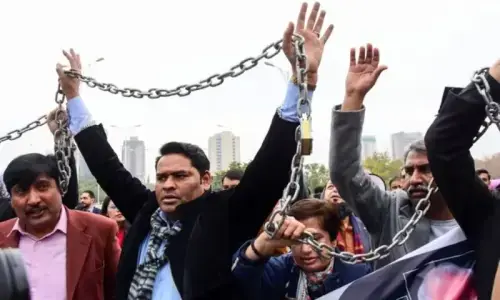
KARACHI: The importance of reclaiming civic space, bringing back student unions and freedom of expression was discussed at an event organised by the Human Rights Commission of Pakistan on Monday.
The programme — Reclaiming public spaces: freedom of association, assembly and expression — was held at the Karachi Press Club and journalist Akhtar Baloch moderated the session.
Other panellists were HRCP’s vice chairperson Asad Iqbal Butt, co-chairperson Uzma Noorani, poet and the commission’s secretary general Harris Khalique, former chairperson Zohra Yusuf, Dr Riaz Ahmed Sheikh and Dr Tauseef Ahmed Khan.
Talking about society at large, Dr Sheikh said that there was suffocation everywhere — particularly at universities and educational institutions. He explained that there were so many things one could and could not teach and discuss and if it fit with a narrative.
An HRCP event discusses importance of freedom of association, assembly and expression
“In the same way, there are so many activities that we can and cannot hold at varsities — this includes events on Balochistan, missing persons and freedom of expression. Nor are they encouraged. How is this done — in some cases the state does this directly and indirectly by putting pressure on universities. This is how a university becomes less ‘public’. It is also one of the many reasons we haven’t been producing as many intellectuals and academics as we should,” he said while speaking at the event.
“Why is there a need to reclaim civic space … you know that better than me. I would like to talk about ways we can reclaim this space. What I have noticed, is that over the years, the relationship between academics, activists and students is weak and because of this protests and movements suffer,” he said.
“If you don’t have freedom of expression, how can you talk about academics and education for all or anything else? If you talk to journalists who cover the economy and business, they will tell you about what kind of pressures they have faced. Freedom of expression is intrinsically linked with society and cannot be ignored,” said Mr Khalique, the writer behind Crimson Papers: Reflections on Struggle, Suffering, and Creativity in Pakistan.
He spoke at length about Karachi and the press club. He remembered two events he attended — Habib Jalib’s 57th birthday and the launch of Zamir Niazi’s Press in Chains, which left a deep impact on him.
He also spoke about colonial institutions versus public ones, plight of journalists and importance of student and trade unions.
The event was attended by members of civil society, lawyers, human rights activists, academics and students.
Earlier, HRCP’s regional coordinator Kaleem Durrani presented the welcome address.
Published in Dawn, December 24th, 2019