More polio cases now caused by vaccine than by wild virus: report


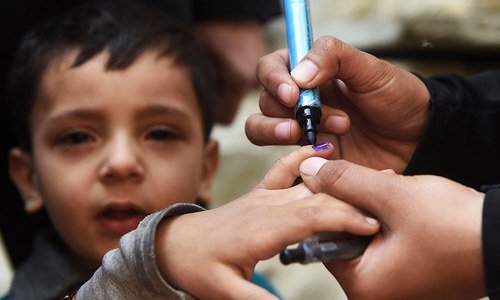
LONDON: Four African countries have reported new cases of polio linked to the oral vaccine, as global health numbers show there are now more children being paralysed by viruses originating in vaccines than in the wild.
In a report late last week, the World Health Organisation and partners noted nine new polio cases caused by the vaccine in Nigeria, Congo, Central African Republic and Angola.
Seven countries elsewhere in Africa have similar outbreaks and cases have been reported in Asia, including the two countries where polio remains endemic, Afghanistan and Pakistan.
In rare cases, the live virus in oral polio vaccine can mutate into a form capable of sparking new outbreaks. All the current vaccine-derived polio cases have been sparked by a Type 2 virus contained in the vaccine. Type 2 wild virus was eliminated years ago.
Polio is a highly infectious disease that spreads in contaminated water or food and usually strikes children under 5. About one in 200 infections results in paralysis. Among those, a small percentage of children die when their breathing muscles are crippled.
Donors last week pledged $2.6 billion to combat polio as part of an eradication initiative that began in 1988 and hoped to wipe out polio by 2000. Since then, numerous such deadlines have been missed.
To eradicate polio, more than 95% of a population needs to be immunised. WHO and partners have long relied on oral polio vaccines because they are cheap and can be easily administered, requiring only two drops per dose.
The Independent Monitoring Board, a group set up by WHO to assess polio eradication, warned in a report this month that vaccine-derived polio virus is spreading uncontrolled in West Africa, bursting geographical boundaries and raising fundamental questions and challenges for the whole eradication process.
Published in Dawn, November 26th, 2019