Reference against Isa modelled on Panama Papers, says lawyer



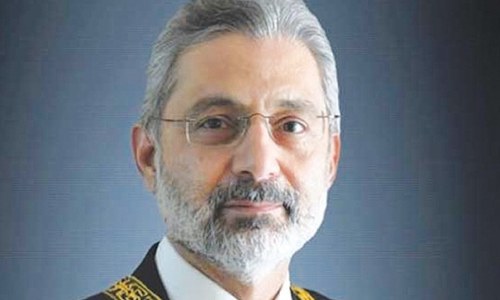
ISLAMABAD: Advocate Babar Sattar argued before the Supreme Court on Monday that the story in the presidential reference against Justice Qazi Faez Isa was painted with the ‘Panama’ brush by disregarding prevalent laws.
The facts against Justice Isa in the federal government’s rejoinder to the Supreme Judicial Council (SJC) reflects the populous bent on the 2017 Panama Papers case similar to the allegations of amassing offshore properties through money laundering and other means,
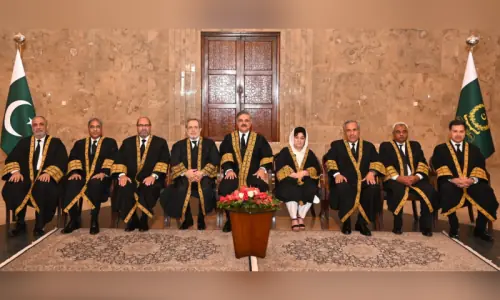
Mr Sattar argued before a full court hearing a set of challenges to the presidential reference against Justice Isa of the Supreme Court. The counsel said he had mentioned the 2017 Supreme Court judgement in the Panama Papers case under which former prime minister Nawaz Sharif was disqualified under Article 62 of the Constitution for life for holding iqama (residence permit).
At the outset of the hearing, Justice Umar Ata Bandial, who heads the 10-judge bench, greeted Babar Sattar by saying “welcome to the rostrum”.
At this, Mr Sattar acknowledged that this was his first time before the full court and he might not be as erudite as Advocate Munir Malik.
“If your writing is a reflection, I think you will do well,” said Justice Bandial.
The counsel argued that the legal duties and obligations for citizens must be founded in law rather than on a vague rhetoric of morality and cited Article 4 of the Constitution to establish that the federal government had to first spell out obligations of a citizen under a proper law.
The counsel also quoted some excerpts from a 2007 Supreme Court judgement to emphasise that the executive did not enjoy any inherent power except those defined by the law. Hence any invasion on the rights of a citizen has to be established first under the law.
The Income Tax Ordinance (ITO) is not an exception since it deals with an individual’s responsibility and does not require an entire family to file collective tax returns, the counsel argued. The reference acknowledges that the offshore properties were in the name of Justice Isa’s wife and children and did not belong to the judge.
The counsel emphasised that since a judge of the Supreme Court was also a citizen, all fundamental rights available to a citizen were available to him as well.
Article 209 of the Constitution, through which superior court judges are removed, provides additional protection to the judge, Babar Sattar argued, explaining that since this provision was a protective law, it did not take away any fundamental right of the judge.
The counsel then referred to Article 10A of the Constitution regarding right to a fair trial and argued that the due process cannot be bypassed even against a judge.
“Perhaps you are arguing that the contents of the reference do not meet the threshold to be referred it to SJC,” observed Justice Maqbool Baqar.
“We will first have to exhaust all relevant statuettes or forums before it becomes ripe to constitute a reference,” contended the counsel.
Justice Muneeb Akhtar observed that Article 10A had nothing to do with Article 209, but Babar Sattar replied that it cannot be assumed that Article 10A would stand suspended if a judge was facing a reference in the Supreme Judicial Council.
Justice Syed Mansoor Ali Shah observed that since the SJC can never determine facts, a judge against whom the council was conducting its proceedings had to first find a forum for the determination of his rights.
Justice Akhtar again observed that SJC proceeds on misconduct and if there was a legal obligation or duty to disclose assets or liabilities and if that duty has been breached then the question will arise whether such violation amounts to misconduct or not.
Referring to the argument that earlier forums should have been exhausted first before filing of the reference, Justice Bandial observed that such exercise will make proceedings before the SJC a mockery of Article 209 also asking the counsel not to read too much since SJC was not an administrative tribunal but a special tribunal.
Advocate Sattar argued that two sets of facts will apply before SJC like the facts concerning to the judicial functions in which case the council will be the ultimate forum to decide about the judge.
But when it comes to private matters, the SJC will have a soft discretion to determine whether it constitutes misconduct or not, the counsel said, adding that the SJC has to determine first that if there was a pattern or the judge was a habitual violator then it amounts to misconduct in such matters.
The counsel asked whether the breach of any law has been established by different tiers of laws or forum before translating it into the reference, emphasising that the filing of the reference showed that the target had been marked first without following the due process.
Therefore, in this case, the income tax department should have issued notices to the spouse and children of Justice Isa before filing of the reference.
The counsel contended that the reference does not say that the offshore properties were Benami or ostensibly held by Justice Isa or that the money for the purchase of the properties was provided by the petitioner judge or it ever mentioned the breach of the citizenship act or the money laundering act, etc. The counsel will continue his arguments and will deal with whether the Assets Recovery Unit (ARU) was set up under the law or not.
Published in Dawn, November 12th, 2019