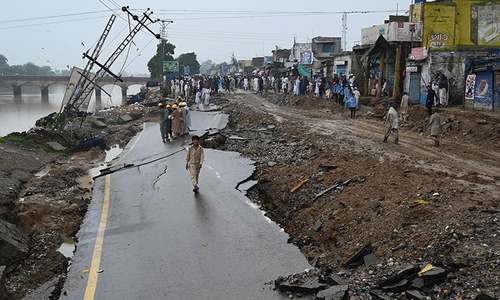
THE earthquake in northern Punjab and parts of Azad Kashmir has brought with it bitter memories from the 2005 catastrophe that claimed almost 75,000 lives. So far, some 40 people have been reported dead in Tuesday’s quake while over 500 have been injured. Cellular network services remained suspended in many places, preventing a more accurate assessment.
While rescue efforts this time were quicker and better than before — perhaps owing to the smaller scale of destruction — the loss of life could have been averted had the authorities put to use the lessons learnt from the 2005 tremor.
The statement given by the National Disaster Management Authority chairman shortly after the quake speaks volumes for the state’s apathy when disaster strikes. Responding to a question, the NDMA chairman said aftershocks could not be ruled out, but the situation was ‘nothing serious’ since there were several fault lines in the country.
Considering that the affected area of New Mirpur lies on the active Samwal-Jharik Kass fault line, which, experts say, was also activated in the 2005 earthquake, this statement is simply absurd and insensitive, and the people who lost their homes and loved ones would disagree with it. The quake was the second major one to have hit the area — that lies in seismic zone 4 (the most at risk) — in two decades. The devastation of the 2005 earthquake should have made a deep impact on how the government views and deals with natural disasters, but unfortunately, we do not seem to be any wiser. The fact that an earthquake preparedness strategy approved by the Planning Commission in 2007 has been lying in cold storage is evidence of this lackadaisical approach.
In terms of geographical location, Pakistan is more prone than many other countries to natural disasters, the incidence of which has drastically increased owing to global warming.
According to a report by the disaster management authority in KP, all 26 districts of the province are now vulnerable to natural calamities because of the increased frequency of extreme weather events (in addition to seismic activity in the region) as compared to only 13 districts a decade ago.
This is also true for the rest of the country that now witnesses torrential rains, floods and droughts on a routine basis. Pakistan’s largest city, Karachi, with all its urban perils including substandard construction, also lies in a zone of ‘noticeable’ seismic danger, according to the Geological Survey of Pakistan. Many areas are so densely populated that only a mild tremor would be enough to incur large-scale loss of lives.
Regrettably, our collective approach towards disaster management leaves much to be desired. It is time the government moved on from ‘first-aid rescue’ — the short-term provision of tents, medicines and food to the affected — to developing and then implementing a comprehensive and sustainable policy to counter disaster and deal effectively with its aftermath.
Published in Dawn, September 26th, 2019