Israel’s two main parties begin talks on coalition govt


JERUSALEM: Israel’s two largest parties met on Tuesday to discuss the possibility of forming a unity government, in a long-shot effort to break the political deadlock following last week’s national elections.
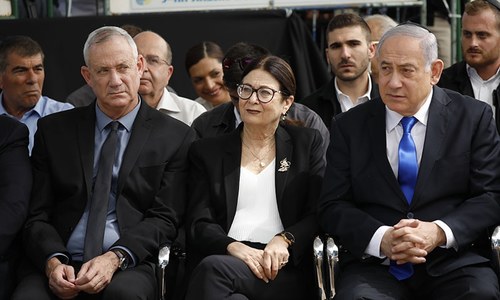
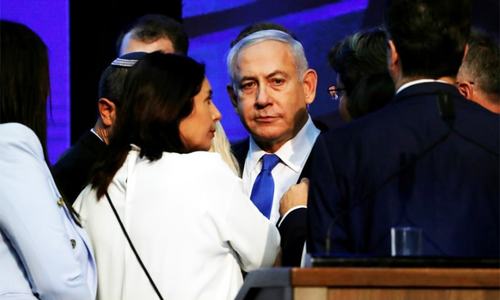
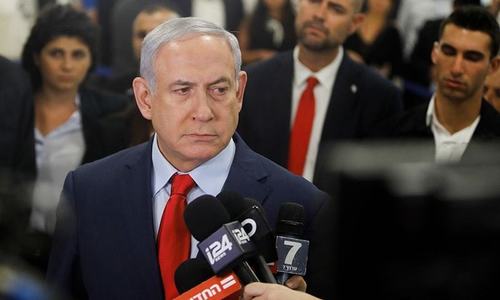
The meeting between party representatives comes a day after Blue and White leader Benny Gantz and Prime Minister Benjamin Netanyahu of the rival Likud party held their first working meeting since the vote. Israeli President Reuven Rivlin brought them together in hopes of breaking an impasse that could lead to months of political limbo and potentially force a third election in less than a year.
“We took a significant step this evening, and now the main challenge is building a direct channel of communication out of trust between the two sides,” Rivlin told the two rivals.
“People expect you to find a solution and to prevent further elections, even if it comes at a personal and even ideological cost.” Israel’s president is responsible for choosing a candidate for prime minister after national elections. That task is usually a formality, but it is far more complicated this time since neither of the top two candidates can build a stable parliamentary majority on his own.
Rivlin summoned Gantz and Netanyahu for another summit on Wednesday before making his decision. No breakthrough is expected, and it is unclear which way Rivlin is leaning.
On Tuesday, negotiators from the two parties met for what they described in a joint statement as a “matter-of-fact” meeting “held in good spirits.” Gantz’s centrist Blue and White came in first in the elections, with 33 seats, trailed by Netanyahu’s Likud with 31. With smaller allied parties, a total of 55 lawmakers have thrown their support behind Netanyahu, against 54 for Gantz, leaving both men short of the required 61-seat majority.
A unity deal between the large parties, with a rotating leadership, is seen as perhaps the only way out of the gridlock. That’s what Avigdor Lieberman, the leader of the ultranationalist Yisrael Beitenu party, is insisting upon. Lieberman, who controls eight seats, has refused to endorse either candidate and is demanding they join him in a broad, secular unity government that excludes the ultra-Orthodox parties Netanyahu’s long-time partners. A former aide and ally of Netanyahu, Lieberman forced the Sept 17 repeat vote by refusing to join Netanyahu’s coalition and robbing him of his parliamentary majority.
Both Netanyahu and Gantz have expressed support for a unity government but have deep disagreements over its agenda and who should lead it.
Published in Dawn, September 25th, 2019