Senate panel resents inclusion of 44 unapproved projects in PSDP


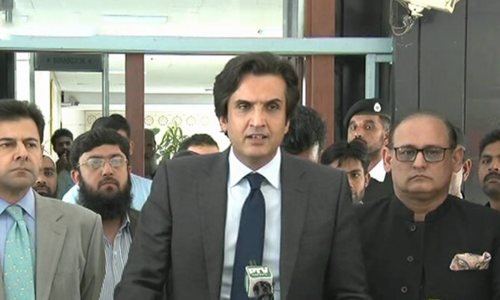
ISLAMABAD: Amid criticism by a Senate committee over inclusion of 44 unapproved projects in the development programme, the federal government on Friday promised to launch $3 billion investment in Karachi to improve its water supply and sewerage systems and infrastructure.
Chairman of the Senate Standing Committee on Planning and Development Agha Shahzaib Durrani (PML-N) and Leader of the House in the Senate Shibli Faraz (PTI) were unanimous in expressing concern that such a large number of unapproved projects had been included in the development programme in violation of prudent development rules and procedures.
Senator Durrani expressed reservation over inclusion of 44 unapproved schemes which had not appeared in the Public Sector Development Programme (PSDP) documents presented to the Senate and the standing committee.
The committee during its meetings on budget proposals had been assured that no new projects under provincial domain and no unapproved projects would be included in the PSDP, he said. Such inclusion of projects in the PSDP was “unconstitutional”, he added.
The committee also observed that it had been assured that no projects were to be funded from the PSDP which were actually to be funded under Sustainable Development Goals and at the same time no recommendation of the Senate had been entertained at any time for such schemes. Despite all these assurances, 44 unapproved projects were included in new PSDP book after the budget, which was never presented in the Senate.
Centre promises to invest $3bn in Karachi projects
Even, Leader of the House Faraz also expressed concern over the procedure adopted for finalisation of the schemes.
The panel constituted a sub-committee comprising Senators Mir Kabeer Mohammad Shahi, Rukhsana Zuberi and Hidayatullah to probe this matter.
Karachi projects
During a discussion on the Greater Karachi Bulk Water Supply Project (K-IV), Minister for Planning Makhdum Khusro Bakhtyar said the project faced serious design faults and its estimated cost had gone up from Rs26bn to more than Rs130bn. He said the country’s largest city required about 1,200 million gallons per day (MGD) of water, but its current supplies were no more than 500MGD, leaving a shortfall of 700MGD.
He said one of the reasons behind the delay and cost escalation was that the provincial government had not provided its share of the project funding.
The minister said the government had been engaged with the World Bank and the Asian Development Bank for assistance over the project. He added that he had taken a World Bank team to Karachi a few days ago for this purpose.
He said the government had prioritised Karachi’s water supply, sewerage and sanitation and infrastructure development and would be investing about $3bn in these areas shortly. He said the authorities concerned would have to properly charge and recover water supply costs from consumers because free water supply could not be made possible for an urban centre.
The committee was informed about flaws in the project alignment proposed by consultants and challenges being faced in transmission and distribution channels of water. Mr Bakhtyar said he had held a meeting with the government of Sindh a few days ago and the matter was discussed at length. He said that in addition to realignment of K-IV project, K-I, K-II, K-III also needed to be optimised. He said the National Engineering Services Pakistan (Nespak) had presented the initial K-IV design review findings and had proposed design improvements after completion of a technical study by it by end of September 2019.
Nespak would submit a complete feasibility study of technically viable and economically feasible solution of K-IV project to the Sindh government in two months, Mr Bakhtyar said. The Joint Technical Review Committee would review and assess the Nespak report.
The chairman of the committee highlighted the need for paying due consideration to the kind of consultants hired for such projects as they often contributed to cost escalation and extended timelines. The committee also observed that responsibility lied on the ministry of planning that vetted all projects and it had to have responsible people for this job.
The committee directed the planning ministry to investigate the delays and irregularities in K-IV project and penalise the responsible people.
The committee urged the Alternative Energy Development Board to share the draft Alternative and Renewable Energy Policy 2019 with it to seek its input and also asked for an extensive briefing on what incentives were being provided to investors in renewable energy sector and how the new policy would be different from the existing one.
Leader of the House Faraz said renewable energy was being discouraged by design and many people who came to invest in this sector were leaving. He said the investors had to be incentivised, but there was a strong and active lobby which did not want their businesses to be affected.
On extensive amounts being paid as subsidy to tube wells in Balochistan, the committee observed that there should be a permanent solution to this by either solarising the tube wells or some other way.
The planning minister said the power ministry would have to take lead in this regard and the finance and planning ministries would be assisting the former.
It was decided to call a joint meeting of the federal power and planning ministries and the Balochistan government to discuss the matter.
The committee was told that the feasibility study on water table situation in Balochistan would be completed by March 2020 and then a work plan would be formulated.
It was informed that Gwadar’s water demand stood at 7.48 MGD but supply was no more than 2.5 MGD and that with completion of Shadi Kour Dam transmission line, the city would get additional 5 MGD of water. However, the distribution network is still not in place.
Published in Dawn, September 7th, 2019