



 0
0

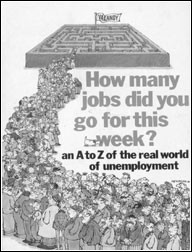 UNEMPLOYMENT is measured by the number of people seeking jobs. The unemployment rate is unemployment as a percentage of the labour force. It is a form of instability in an economy when aggregate supply exceeds aggregate demand or results from a variety of social, vocational, technological and other specific market factors.
There are two methods to work out the total number of the unemployed but both can prove to be unreliable: claimants count and the labour force survey.
In the first case, the method simply involves taking a count of the number of unemployed people claiming benefit. Since the method has many defects, the labour force survey is seen as more appropriate.
Unemployment can be measured either as the number of people in ‘000s or millions and this is the most quoted figure. However, to know how significant this number is, we have to calculate the number of the people as a percentage of the labour force.
Perhaps, the main cost of unemployment is a personal one to those who are unemployed. However, if they suffer, then the whole economy suffers. When individuals become disheartened by unemployment, they lose confidence which affect their health and motivation to work. The longer they remain unemployed, they are likely to lose their skills which would be bad for the national economy as well. The whole economy suffers when a large number of people are unemployed.
The effects of unemployment include: the GDP is lower when the unemployed are not earning and are not producing goods and services. The higher employment firms are likely to do better and make better profits.
There are different causes of unemployment and in most cases, it is never easy for governments to identity which cause is the most important and how to remove it. However, these causes could be split into two main categories: demand-side and supply-side.
There may be simply a lack of aggregate demand. When there is not enough demand, employers will not need as many workers and so the demand-deficient unemployment results.
Unemployment is also caused by the supply-side factors results from imperfections in the labour market. A perfect labour market will always be clear and those looking for jobs will be working—- supply will equal demand. However, if the market does not clear properly, there may be unemployment. This may happen because wages do not ‘fall properly’ to clear the market.
The supply-side unemployment may also happen because there is occupational or geographical immobility. It may happen because there is poor information about job opportunities. This will mean people taking a long time looking for jobs, increasing the level of frictional or search unemployment.
Another cause of unemployment which is not much discussed but is no less important is changes in total workforce. The workforce is made up of people who are of working age and not currently in full-time education. Their number will change with the demographic (age) structure of the population.
If there is a baby-boom (a rapid increase in the birth rate) then these people will become of working age between 16 and 21 years later. They then join the work-force. If there is the same number of people retiring from the work-force at the other end, then unemployment will stay the same.
However, following a baby boom there are often more joining the work-force than leaving? This may increase unemployment, unless there are enough extra jobs created to employ the extra people in the work-force. This was one of the causes of unemployment in the early 1980s when people born in the baby-boom of the 1960s joined the work-force.
Unemployment and productivity: During the later half of the 1990s, productivity grew at almost twice the pace of the preceding ten years. Widely attributed to developments in the information technology sector, this surge in productivity was accompanied by an unemployment rate that dropped to unusually low levels. Another example of this relationship between productivity and unemployment—though in the reverse direction- is the decade of the 1970s.
Productivity growth slowed sharply in the early 1970s (and stayed low for several decades), while unemployment increased noticeably. While both productivity and unemployment do respond to other changes in the economy, these episodes make one wonder about the impact that independent (perhaps technology- driven) changes in productivity might have on the unemployment rate.
The search theory of unemployment starts with the assumption that workers have different skills and that jobs have different skill requirements. Workers need to find well-paying, desirable jobs, while firms need to find the most productive workers. Neither firms nor workers have all the information they need about the options available to them, so they must engage in search.
Firms now routinely post vacancies on the Internet, so that workers can look for jobs in multiple (perhaps remote) locations at almost no cost. Several million resumes are now estimated to be online and that the Internet is available to roughly half the US population.
These developments should help reduce the amount of time that firms and households have to spend searching for the right match, and so should help lower the equilibrium unemployment rate.
Changes in the long-run growth rate of the economy also can affect the equilibrium unemployment rate-even without a change in the search technology.
The firm’s decision to hire a worker involves balancing the costs of hiring that worker against the profits that will accrue once the worker is hired. The hiring costs are incurred now, while the profits are realized over time.
Other things being equal, an increase in the trend rate of growth raises future profits and makes it attractive to increase hiring today. Thus, an increase in the trend growth rate will lead to a decrease in unemployment, while a decrease in the trend growth rate will lead to an increase in unemployment.






























