Insecurity to remain major concern even after Afghan peace deal: US agency



WASHINGTON: Afghanistan will continue to grapple with multiple extremist organisations even if the United States and Taliban reach a peace settlement, warns John Spoko, the US Special Inspector General for Afghanistan Reconstruction (SIGAR).
SIGAR has a mandate from the US Congress to monitor the 18-year-old war in Afghanistan and submit a quarterly report to the lawmakers on Washington’s efforts to restore peace and stability to the war-torn country.
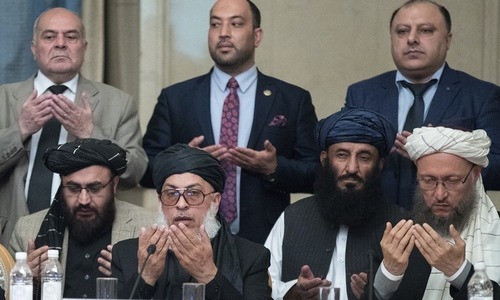
SIGAR’s “High-Risk List” for 2019 was highlighted by the US media this weekend as US and Taliban representatives resumed their talks in Doha, Qatar.
“With or without a peace settlement, Afghanistan will likely continue to grapple with multiple violent-extremist organisations who threaten Afghanistan and the international community,” the SIGAR report warns.
The report refers to the “capability challenges” of the official Afghan forces while referring to the recent increase in Taliban attacks on their positions.
“The Afghan National Defence and Security Forces (ANDSF) are constrained by capability challenges and depend on donor support of $4 billion to $5 billion per year to fund their sustainment, equipment, infrastructure, and training costs,” the report notes.
SIGAR points out that Nato’s military mission in Afghanistan — known as the Operation Resolute Support (RS) — also acknowledges that the “control of Afghanistan’s districts, population, and territory has become more contested over the last two years, resulting in a stalemated battlefield environment”.
The report highlights eight high-risk areas: Widespread insecurity, underdeveloped civil policing, endemic corruption, sluggish economic growth, illicit narcotics trade, threats to women’s rights, reintegration of ex-combatants and restricted oversight. The report notes that since fiscal year 2002, Washington has appropriated $132.3bn for Afghanistan reconstruction, of which $83.1bn — or 63 per cent — has gone toward building and sustaining a more effective and sustainable security force.
“The most enduring threat to the Afghan reconstruction effort, and to the US taxpayer’s investment in that effort, has been an ongoing and resilient insurgency and the presence in Afghanistan of terrorist groups such as Islamic State-Khorasan (IS-K),” the report adds.
It warns that even if the Doha talks lead to an agreement, “Afghanistan will continue to need a security force to protect the Afghan population from internal and external threats, provide a policing function to respond to criminal activity, and control its borders.”
“Any political settlement entails the risk that not all subordinate groups will abide by an agreement made by their organisation’s leadership,” SIGAR warns. “Therefore, insecurity could potentially persist in the form of another insurgency, criminal gangs, or networks involved in other nefarious activities.”
Published in Dawn, July 1st, 2019