Non-implementation of SC order on minorities’ rights regretted


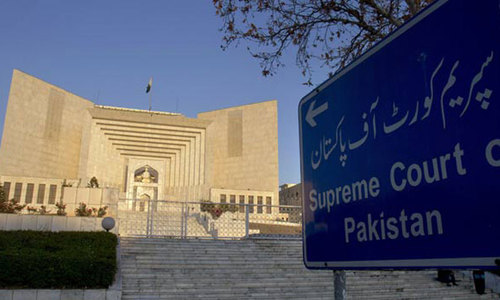
ISLAMABAD: Politicians, lawyers, rights activists and representatives of minorities on Wednesday celebrated the landmark Supreme Court judgement on the protection of religious minorities’ rights.
They, however, regretted that the judgement pronounced on June 19, 2014, could not be implemented even after five years.
They were speaking at a seminar titled ‘Protection of Minorities Rights’ organised by the Human Rights Commission of Pakistan (HRCP) in collaboration with the Centre for Social Justice (CSJ), the National Commission for Justice and Peace (NCJP) and the Cecil and Iris Chaudhry Foundation at a local hotel.
Read: SC orders formation of national council for minorities' rights
In its judgement the Supreme Court had suggested a framework for the protection of the minorities. A key recommendation was the creation of a national council to oversee the interests of the minorities but it could not be done.
Judgement ruled on June 19, 2014 has not been carried out even after five years
Former senator Farhatullah Babar said that true religious harmony is spiritual in nature that can best be achieved by building intellectual infrastructure in an environment of freedom of expression instead of administrative orders or judicial pronouncements. He said laws, executive orders and court verdicts will not end militancy and hate speech as was witnessed in the murder of Salmaan Taseer by his own guard and the state’s surrender before violent extremists of Faizabad sit-in.
Mr Babar said the state nurtured snakes in its backyard hoping that they will only bite neighbours. Hate speech will not end as long as hate-mongers are nurtured and protected, he added.
“Pakistan is both a majoritarian and a security-driven state. In a majoritarian state, the minorities suffer while in a security state the selective application of laws is determined by the security establishment,” he said.
Chairman of the National Commission for Human Rights (NCHR) Justice (retd) Ali Nawaz Chohan said it is unfortunate that the minorities are suffering in Pakistan.
“I asked one Kalash person why he converted to Islam and his reply was that he had no option. The apex court judgement says Pakistan is in transitional democracy, I wish there was a full-fledged democracy,” he said.
HRCP’s honorary spokesperson I.A. Rehman said that the non-implementation of the judgement was “not just a matter of concern for the minorities alone. It is the concern of all Pakistanis”.
He said the states that do not take good care of their minorities, perish. Yet the state has created an environment in which the media is afraid to discuss the problems faced by religious minorities.’ “We need to change our minds because in Pakistan even Muslims are not equal to Muslims as rich Muslims are considered better than poor Muslims. Moreover, women are not equal to men. I suggest that small steps should be taken for a big change,” he said.
Justice (retd) Nasira Iqbal said it is not just that the judgement has to be implemented, but that its “ethos must be understood and pursued”.
HRCP Secretary General Harris Khalique said that Allama Iqbal’s poetry was edited in Pakistan and was made what was considered to be in accordance with Islam. He said there is constitutional discrimination against minorities.
Archbishop Joseph Arshad said that during discussion it was observed that there was lack of resources, political will and capacity due to which issues of the minorities could not be addressed.
Educationist Prof A.H. Nayyar said that religious tolerance means understanding other religions and giving them respect. “Unfortunately we are against diversity and want to bring uniformity,” he said.
Describing the judgement as a “key catalyst in building pro-minority jurisprudence in Pakistan”, Peter Jacob, executive director of CSJ, criticised the state’s apparent reluctance to proceed on the judgement’s directives. Educationist Kalyan Singh said that though minorities are 3.5 per cent in Pakistan but only 2.5pc job quota is allocated for them. “Even 96pc, of 2.5pc, quota is filled with sanitary workers,” he said.
Rights activist Tahira Abdullah said that people speak about job quota for the minorities but it cannot be implemented unless education quota is not fixed for them.
Representative of the Kalash community Imran Kabeer said that only 3,800 Kalash people were left because of continuous efforts to convert them.
Published in Dawn, June 20th, 2019