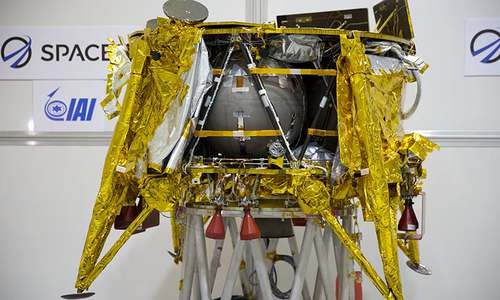
Israeli spacecraft crashes during moon landing

TEL AVIV: An Israeli spacecraft lost contact with Earth and crashed just moments before it was to land on the moon late on Thursday, failing in an ambitious attempt to make history as the first privately funded lunar mission.
The spacecraft lost communication with ground control as it was making its final descent to the moon. Moments later, the mission was declared a failure.
“We definitely crashed on surface of moon,” an official of Israel Aerospace Industries said. He said the spacecraft was in pieces scattered at the planned landing site.
The spacecraft’s engine turned off shortly before landing. By the time power was restored, the craft was moving too fast to land safely. Scientists were still trying to figure out the cause of the failure.
“One of the inertial measurement units failed. And that caused an unfortunate chain of events we’re not sure about,” the official said. “The engine was turned off. The engine was stopped and the spacecraft crashed. That’s all we know.”
The mishap occurred in front of a packed audience that included Prime Minister Benjamin Netanyahu and was broadcast live on national television.
The small robotic spacecraft, built by a non-profit SpaceIL and state-owned Israel Aerospace Industries, had hoped to match a feat that has only been achieved by the national space agencies of three countries: US, Russia and China.
“If at first you don’t succeed, try again,” Netanyahu said. He vowed to put an Israeli spacecraft on the moon “intact” in the next two years.
Scientists, who were giddy with excitement only seconds earlier, were visibly distraught, and celebrations at viewing centres across the country were dashed.
President Reuven Rivlin hosted dozens of youngsters at his official residence. The children, some wearing white spacesuits, appeared confused as the crash unfolded.
“We are full of admiration for the wonderful people who brought the spacecraft to the moon,” Rivlin said. “True, not as we had hoped, but we will succeed in the end.”
Published in Dawn, April 12th, 2019