PM, army chief discuss security matters

ISLAMABAD: Prime Minister Imran Khan and Chief of the Army Staff Gen Qamar Bajwa on Thursday held security consultations.
In a brief statement issued after the meeting, the PM Office said that the army chief had called on Prime Minister Khan at PM Office where they discussed various important security-related matters.
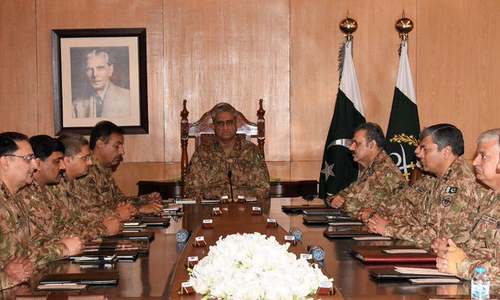
The meeting was held two days after the corps commanders’ conference, which deliberated on the security matters. The Inter-Services Public Relations (ISPR) had in a statement on the corps commanders’ conference said: “The forum also expressed its resolve to support government and all stakeholders in implementation of National Action Plan.”
Explore: Expert Working Groups to be set up for NAP coordination, implementation
Gen Bajwa had on that occasion told his commanders that the country was on the path to becoming “a state where prerogative of use of weapons rests with the state alone”.
The government and other law enforcement agencies have lately stepped up their counterterrorism actions to meet the requirements of the Financial Action Task Force (FATF) in view of the looming May deadline for a review ahead of the June plenary of the global illicit financing watchdog.
The Asia-Pacific Group, a regional affiliate, had in its recent evaluation expressed dissatisfaction on the progress Pakistan had made towards fulfilment of the commitments it had made last year for removing the weaknesses in its anti-money laundering and counter-terror financing regimes.
Read more: Action against banned groups has nothing to do with FATF: Afridi
Alongside FATF pressure, the other pressing issue for the government and the military is the extension of the military courts. The legislation covering the military courts had expired on March 30. The government intends to seek a second time extension for the special military tribunals, but has been unable to get the opposition on board.
The National Assembly is reconvening next week (April 12), but as of now the government does not appear to be in a position to table the bill for granting a second extension to the courts.
The government has a slim majority in the National Assembly and is in minority in the Senate. It can, therefore, not provide the two-thirds majority vote in favour of the legislation. The government has now linked the tabling of the bill for extension of military courts to political consensus.
Find out more: CJP Khosa vows to ascertain a universal 'definition of terrorism'
The PML-N, the main opposition party, is disposed in favour of the military courts, but is reluctant to extend its support because of the PTI government’s attitude. The other major opposition party PPP has, however, taken a position that it would not support such a bill.
Information Minister Fawad Chaudhry said that the National Action Plan had been adopted as a strategy for fighting extremism through consensus among the political parties, and that the government wanted future decisions related to the NAP to continue to be taken through the unanimity of all parties.
Published in Dawn, April 5th, 2019