Corps commanders resolve to support govt in implementation of NAP
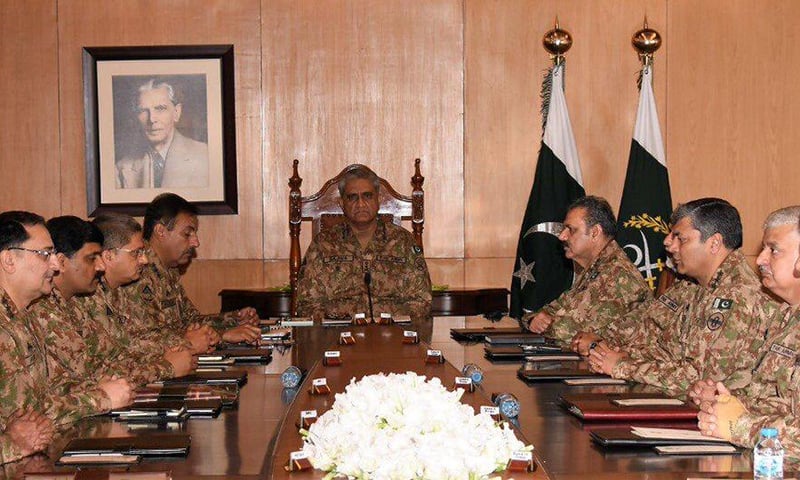
Chief of Army Staff Gen Qamar Javed Bajwa on Tuesday chaired the 220th Corps Commanders' Conference at General Headquarters (GHQ) in Rawalpindi.
During the meeting, all participants resolved to support the government and all stakeholders in the implementation of the National Action Plan, according to a press release issued by Inter-Services Public Relations.
During the conference, the geo-strategic environment as well as the ongoing situation along the Eastern border came under discussion.
According to the press release, the participants of the meeting "expressed strong will, resolve and determination to defend the motherland against any misadventure or aggression".
The corps commanders also reiterated their commitment towards "bringing enduring peace in the country while supporting all initiatives towards regional peace", said the ISPR statement.
"Having achieved successes against terrorism, Pakistan is on a positive trajectory of becoming a state where prerogative of use of weapons rests with the state alone and socio-economic development is taking preeminence," the army chief was quoted to have said during the session.
A new National Action Plan
According to a Nov 2018 Dawn report, the Interior Ministry has been working on a new version of the NAP ─ described as Interior Minister Shehryar Afridi's brainchild ─ and the restructuring of the National Counter Terrorism Authority (Nacta) to effectively tackle internal threats to security.
A document outlining the ministry’s performance during the first 100 days of the PTI government and its future plans says that NAP-2 is aimed at bridging the gaps in the first version which was rolled out in January 2015.
Last week, Prime Minister Imran Khan had chaired the first ever meeting of the National Internal Security Committee (NISC).
Prime Minister Khan had told attendees that implementation of the NAP is the government's foremost priority as it is the reflective of the will of the nation, and a consensus document which was agreed upon by all political parties in the country. It was decided by the committee to form Expert Working Groups to ensure seamless coordination on, and implementation of, the NAP to counter terrorism.
A briefing on the plan and its implementation is due and the main opposition parties have declared that they will attend the NAP briefing only if it was held in the parliament and delivered by the prime minister.