JUI-F lawmaker suggests abolition of reserved seats for minorities


 5
5


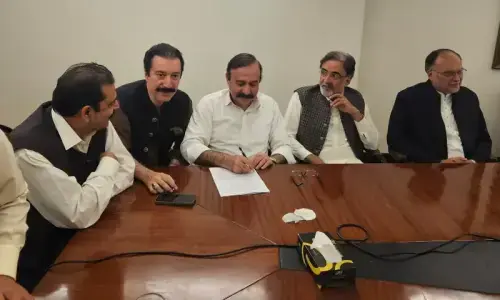
ISLAMABAD: A proposal by Jamiat Ulema-i-Islam-Fazl (JUI-F) lawmaker to abolish reserved seats for women and minorities divided members of a parliamentary committee on Tuesday.
The National Assembly Standing Committee on Law and Justice at a meeting chaired by MNA Riaz Fatyana was considering The Constitution (Amendment) Bill 2018 moved by MNA Naveed Aamir Jeeva and The Constitution (Amendment) Bill 2018 moved by MNA Dr Ramesh Kumar Vankwani suggesting increasing the reserved seats for minorities.
Take a look: Will ensure minorities treated as equal citizens in Naya Pakistan, vows PM on Quaid's birth anniversary
But JUI-F legislator Aliya Kamran came up with a proposal to abolish the reserved seats for women and minorities saying the reserved seats were weakening the minorities.
Aliya Kamran tells NA body that minorities should be mainstreamed as increasing seats would weaken them
“Issues of minorities would not be addressed even if we increase the number of seats for them because they would not be able to address their issues. Moreover, Dr Vankwani was a part of the previous government and his similar bill could not sail through parliament then. Now he is also a part of the government but it is not for sure if his bill would sail through the parliament,” she said.
Ms Kamran suggested that there should be democracy within political parties and mainstreaming of minorities should be ensured.
The MNA said though she had reached the assembly on a reserved seat she was not in favour of reserved seats.
PML-N legislator Rana Sanaullah Khan, who seemed to agree with Ms Kamran, said there were no reserved seats in the United Kingdom due to which a number of Pakistani origin/Muslim people had secured important positions in political parties.
“We should provide opportunities to minorities so that they could be mainstreamed and reach parliament through direct elections,” he said.
Mr Khan, who served as the law minister of Punjab, said according to rules a relief given to any segment of society cannot be withdrawn. So he suggested that the reserved seats should not be increased.
However, Pakistan Tehreek-i-Insaf (PTI) legislator Sanaullah Khan Mastikhel wondered if political parties were so developed to get votes.
“I belong to southern Punjab and know votes in the area are cast on the basis of Biradaris. Politics has changed in India but not in Pakistan,” he said.
Committee member Shunila Ruth, who was nominated as the MNA on a minority seat by PTI, said perhaps Ms Kamran was not living in Pakistan.
“We should analyse if we have progressed so much that marginalised segments of society would be uplifted. Even women cannot become MNA through direct elections. The concept of reserved seats was introduced to give an opportunity to people to speak about their issues. Unfortunately, no one speaks about the issues of minorities. We should give a voice to the voiceless,” she said.
MNA Malik Mohammad Ehsanullah Tiwana said mainstreaming of minorities could not become possible in the past and may not be possible in the next 40 years.
He suggested that the number of reserved seats for minorities should be increased so that they would speak about their rights.
The mover of the bill said the reserved seats for minorities should be increased as otherwise their issues would not be addressed.
After deliberations, the committee deferred the bills with an observation that a subcommittee shall be constituted which would formulate specific recommendations.
During discussion on the reports of judicial commissions regarding a terrorist attack on the Sri Lankan cricket team in Lahore and murder of judges in the district jail of Sialkot, an official of the Punjab home department informed the committee that due to paucity of time it was not possible to dig out the old record.
He sought more time to provide the same. The committee deferred the same to the next meeting.
Published in Dawn, April 3rd, 2019