NA panel seeks funds to transfer Rangers’ HQ from Jinnah Courts

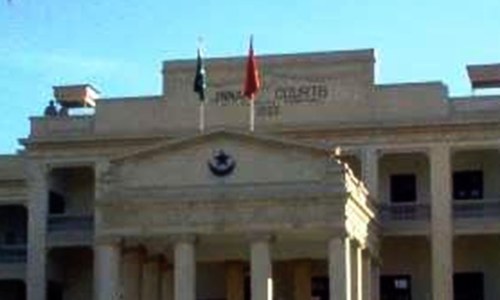
ISLAMABAD: A National Assembly panel on Wednesday called for provision of ‘adequate’ funds to the Sindh Rangers for shifting their headquarters from Jinnah Courts — a historically significant pre-Partition national heritage building in Karachi.
The NA standing committee, which met here with Raja Khurram Shahzad Nawaz in the chair, also sought details of funds provided to the Sindh Rangers and their distribution to date.
Originally named the Leslie Wilson Muslim Hostel, Jinnah Courts were constructed through the use of donations from citizens as well as provincial local bodies to provide residential facilities to students who came from across Sindh to pursue their studies. Its foundation stone was laid in June 1932, and the building was inaugurated a year later in June 1933. The hostel remained a place of high importance during the Pakistan Movement, with Mohammad Ali Jinnah also having visited. Soon after independence, the building was renamed after Mr Jinnah.
Recruitments made in Nadra recently also came under discussion
Responsibility for the building was transferred to the culture department in 1986 and the Rangers shifted their headquarters there (on a temporary basis) in April 1999. Earlier the Rangers headquarters had been housed in the Sheikh Zayed Islamic Centre (SZIC) on University Road, but that had to be vacated when the United Arab Emirates government — that had funded the construction of the SZIC — raised objections to its use by the law enforcement agency and said that the SZIC was meant for educational purposes.
During Wednesday’s meeting, the committee also raised questions about recent recruitments by Nadra. The relevant ministry was asked to provide details of advertisements published by the identity card issuing organisation over the past one year and the recruitments made accordingly, along with the criteria used. The various issues faced by the public regarding obtaining computerised national identity cards (CNICs) were also discussed. It was emphasised that Nadra devise a system to deliver CNICs to people at their doorstep.
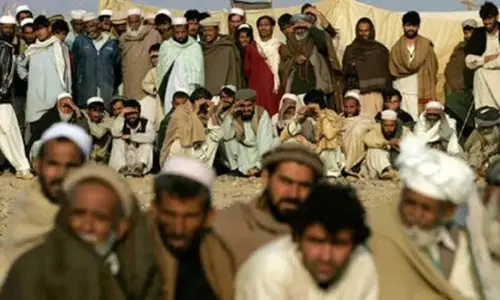
On its part, Nadra presented a briefing during which the committee was informed that the majority of Afghan immigrants came to Pakistan during the war in Afghanistan, onwards from 1978. The authority said that it had blocked ‘suspicious CNICs’ and was working on evolving standard operational procedures to resolve the matter as soon as possible. The committee rejected the National Database and Registration Authority (Amendment) Bill, seeking to allow voters to cast their votes anywhere in Pakistan. The bill has already been rejected by the Senate standing committee on the interior.
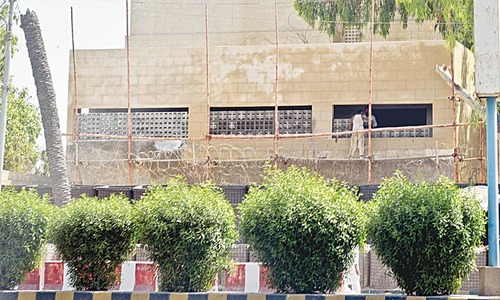
Immigration and Passports Director General Ishrat Ali briefed the committee about functions, performance, organisational structure and challenges faced by the department. The committee instructed that new offices be set up to accommodate citizens’ needs, while district passport offices in Saddar, Karachi, be shifted to the relevant districts to facilitate the public. It further held that action should be initiated against the contractor constructing the Sukkur passport office as regard to delays, with action oriented towards completing the project.
The panel was informed that as many 5,065 Pakistanis renounced citizenship over the past one and a half years, while only 111 foreigners got Pakistani citizenship. Mr Ali commented that many Pakistanis renounced citizenship after getting nationality of countries that had no dual nationality agreement signed with Pakistan, explaining that predominantly, foreign spouses of Pakistani nationals applied for nationality here. He expressed surprise that the number of those who surrendered nationality was higher than those getting the citizenship.
Published in Dawn, March 28th, 2019