The Selected Works of Abdullah the Cossack launched


 0
0
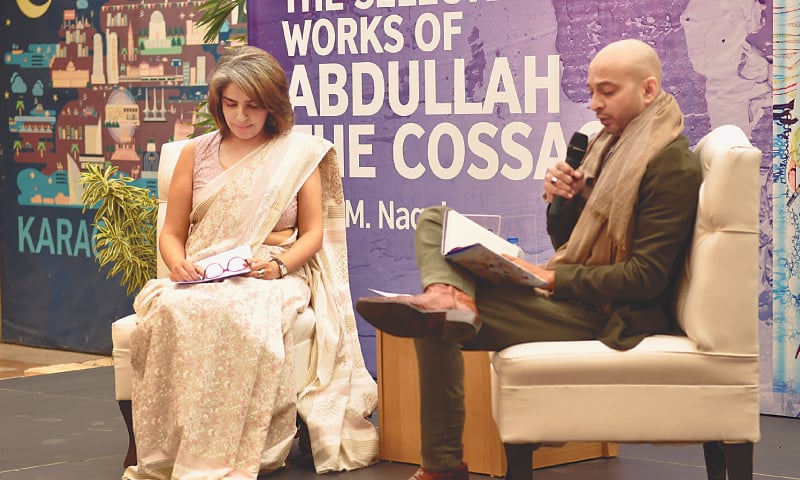

KARACHI: At the launch of H.M. Naqvi’s second novel The Selected Works of Abdullah the Cossack, at the British Council Library on Sunday, the conversation steered towards a potent and larger than life character that the novel showcases — the city of Karachi.
It took Naqvi almost two years to research the city before he embarked on writing the novel which, he explained, is about a 300 pound bachelor, a resident of Garden East, who hails from a business family that has fallen on hard times.
“It took me the first year or two to research about the particular canton of the city — Garden East. I sat with old denizens of the city. The city has not been as well documented as other cities like New York or Delhi. So there is a lot of oral history that I harnessed in creating the world.” The bars, the cafés, the movie theaters, Naqvi went through an arduous process of mapping the city of Karachi as authentically as possible.
It took H.M. Naqvi almost two years to research Karachi before he embarked on writing the novel
“It took several years for me to conjure another voice after completing Home Boy. Abdullah’s voice is figuratively perhaps a voice of the city, but it is also a voice that one hears everyday of denizens of the city that have seen different permutations and incarnations of the city; a time when the city was more animated, more cosmopolitan.” The mapping of a Karachi that is lost sustains throughout the novel.
Responding to a question by writer Bee Gul about the internal architectural structure of the novel, Naqvi started by charting the journey of Abdullah who, he said, “wakes one morning and realises he has turned 70. With that comes the realisation that he has led a life without meaning and considers launching himself of his balcony and ending it all. At the heart of Abdullah’s anxieties is what everybody experiences, some more often than others; some early in life while some much later.”
How does one spend a life that is meaningful is a recurring question in every person? “I too share this anxiety with Abdullah; this particular facet of the protagonist is universal.” Naqvi added, however, that readers bring their own intellectual cues and interpretation to a novel.
Naqvi, whose first novel Home Boy won the DSC prize in 2011, shared the writing process which tends to encompass his entire day yet takes years to complete. “I have a regimented schedule; I work through the night till about 4 or 5 in the morning; I wake at midday, have my first session from 3 to 6 and second session from 9 to 11.”
Every day there is certain quota of words Naqvi must produce. “The quota I keep is 300 words; I hit about 500 words a day. I keep it low so I never feel that I am behind or have squandered the day. And those are the mechanics of my day.”
Fiction continues to have resonance in today’s world, said Naqvi, even more so than political theory, economic theory or even philosophy, calling it a powerful medium and way of looking at the world.
Published in Dawn, February 18th, 2019