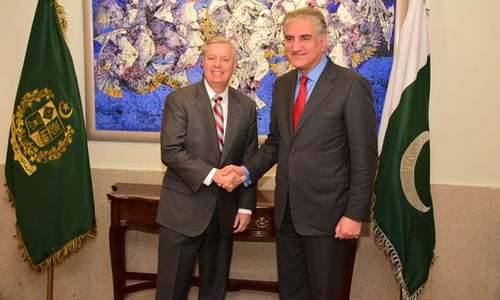
Foreign minister, US delegation discuss 'close engagement' between countries


Foreign Minister Shah Mahmood Qureshi, in a meeting with a bi-partisan United States delegation, said that "close engagement" between Pakistan and US had "historically proved to be a factor for stability in South Asia", a Ministry of Foreign Affairs press release read.
The meeting between Qureshi and the US delegation, which included nine senators and 10 members of the House of Representatives, was held on the sidelines of the Munich Security Conference on Friday.
During the meeting, the foreign minister expressed Islamabad's hope for "a strategic and comprehensive partnership" between Pakistan and the US. Republican Senator Lindsey Graham, who led the US delegation, agreed with Qureshi and also "stressed" upon establishing a Free Trade Agreement between Pakistan and the US — a proposal he had reportedly discussed with Pakistani authorities on his visit to Islamabad last month.
Senator Graham said that he was "impressed" with Pakistan's achievements in the war against terrorism. He also acknowledged that progress made in last month's peace talks, held in Doha, would not have been possible without Pakistan’s assistance.
Commenting on the Afghan peace process, the foreign minister said that Pakistan had always maintained that the conflict in Afghanistan did not have a military solution and assured that Islamabad will continue to extend its "fullest support" to US envoy Zalmay Khalilzad, who is leading peace negotiations with the Afghan Taliban.
Qureshi said that the Pakistan Tehreek-i-Insaf government was "pursuing an ambitious domestic agenda of reform and people-centric development" and in order to achieve that goal regional peace was vital.
He further said that Pakistan wanted to "see peace return to Afghanistan", however, a final settlement could not be reached unless all Afghan parties, as well as regional stakeholders, were on board with the ongoing peace process.
The foreign minister had left for Munich on Thursday to attend the annual Munich Security Conference, where he co-chaired a panel with Afghanistan's President Ashraf Ghani, wherein they discussed the ongoing Afghan issue.
He also met his German counterpart Heiko Maas on the sidelines of the conference and invited German companies to take advantage of Pakistan’s investor-friendly policies, especially in the fields of energy, infrastructure development and agriculture.